Part 3: The Moment a Lie Stops Working
The moment truth enters a room, it doesn’t shout.
It changes the air.
That’s what happened at that table.
Daniel’s hand hovered over the papers, but he didn’t touch them right away. Like he already knew that once he did, there was no going back to the version of things he’d been living in.
Courtney didn’t reach for them at all.
She looked at me first.
Always the strategist.
“Arthur,” she said carefully, “I don’t understand what this is supposed to be.”
“You will,” I replied.
My voice stayed even.
That was important.
Anger gives people like her something to work with. Calm doesn’t.
Daniel finally picked up the top page.
Marcus’s report.
I watched his eyes move.
Line by line.
Meeting by meeting.
Date by date.
The shift in his expression was slow… but unmistakable.
Confusion.
Then disbelief.
Then something heavier.
Something that settles when a man realizes the ground under him isn’t what he thought it was.
Courtney leaned slightly toward him.
“Daniel,” she said softly, “you don’t have to read that right now. We can—”
“Don’t,” he said.
Quiet.
But final.
She froze.
That was the first real crack.
I slid another document forward.
“This is a draft proposal,” I said. “Prepared by your attorney, Ms. Hensley. It outlines the sale of my property.”
Courtney didn’t look at it.
“I don’t know what that is,” she said.
“You do,” I replied. “Because your name is listed as the transitional contact.”
Now she looked.
Just for a second.
But it was enough.
Daniel saw it too.
“You met with a real estate attorney,” I continued. “Three times. Not in her office. In a café. No formal record.”
“That’s not illegal,” Courtney said quickly.
“No,” I agreed. “It’s just careful.”
She straightened slightly.
“I work in development,” she said. “I meet with attorneys all the time.”
“About my building?”
Silence.
Then—
“I was exploring options,” she said. “For us. For the future.”
“For you,” I corrected.
Daniel’s eyes lifted from the page.
Slowly.
He looked at her like he was seeing her from a distance for the first time.
“Why isn’t my name on this?” he asked.
That question… it landed harder than anything I could have said.
Courtney hesitated.
Just a fraction too long.
“It was preliminary,” she said. “There was no reason to include—”
“No reason to include me?” he finished.
Her composure shifted again.
Not broken.
But strained.
“That’s not what I meant,” she said. “I was protecting you from unnecessary stress.”
Daniel let out a small breath.
Almost a laugh.
But there was nothing amused in it.
I placed the next document on the table.
Insurance records.
“Two weeks ago,” I said, “you accessed my private files in my shop and photographed these pages.”
Her head snapped up.
“I did not—”
“There’s camera footage,” I said.
She stopped.
Completely.
The silence that followed was heavy enough to feel.
“You went directly to the file,” I continued. “You knew exactly where it was. You photographed three pages. Then you examined the clock.”
Daniel’s eyes flicked to the clock.
Then back to her.
“Courtney,” he said quietly, “is that true?”
She didn’t answer right away.
Which… was answer enough.
“I was trying to understand the situation,” she said finally.
“By going through my father’s private records?” he asked.
“I didn’t think he’d mind—”
“I do mind,” I said.
Flat.
Final.
The last piece sat in my folder.
I didn’t rush it.
Timing matters.
Always.
“Marcus obtained a recorded call,” I said. “Between you and Ms. Hensley.”
Courtney’s shoulders tightened.
Just slightly.
“In that call,” I continued, “you discussed the timing of ownership transfer. And you mentioned my health.”
“That’s—” she started.
I didn’t stop.
“You said, and I quote, ‘He’s sixty-four. He’s on blood pressure medication. It’s just a matter of timing.’”
Daniel closed his eyes.
Just for a second.
Then opened them again.
Slow.
Controlled.
“Tell me that’s not real,” he said.
That was the moment.
The moment where everything balanced on a single decision.
Truth.
Or performance.
Courtney chose performance.
“That’s completely out of context,” she said quickly. “You don’t understand the conversation—”
“Then explain it,” Daniel said.
Her voice sharpened.
“I was talking about long-term planning. Everyone has to think about these things—”
“You were talking about my father like he was a timeline,” he said.
Silence.
Then—
“I was being practical,” she snapped.
And there it was.
Not the polished version.
Not the careful wording.
The truth.
Cold.
Clean.
Unapologetic.
Daniel leaned back in his chair slowly.
Like something inside him had just settled into place.
“I asked you once,” he said quietly, “if this was about the money.”
Courtney’s expression tightened.
“And you told me it wasn’t,” he continued.
“It’s not just about money,” she said.
That word.
Just.
That was the mistake.
I sat there and watched it happen.
Not with satisfaction.
Not with anger.
Just… clarity.
Because once someone shows you who they are without the mask…
There’s nothing left to interpret.
Courtney stood abruptly.
“This is ridiculous,” she said. “You’re ambushing me with half-truths and assumptions—”
“No,” I said calmly. “I’m presenting you with documentation.”
She looked at Daniel.
Waiting.
Expecting him to step in.
To defend.
To soften.
He didn’t.
“Say something,” she demanded.
Daniel looked at her for a long time.
Longer than he had looked at anything that night.
Then he spoke.
Quiet.
Measured.
Clear.
“I don’t recognize you,” he said.
That sentence ended it.
Not the documents.
Not the evidence.
That.
Courtney’s composure broke then.
Not completely.
But enough.
“You’re overreacting,” she said. “This is exactly what your father wants—he’s turning you against me—”
“No,” Daniel said.
Same tone.
Same calm.
“You did that yourself.”
She grabbed her purse.
Hands tighter now.
Movements sharper.
“I’m not staying here for this,” she said.
I nodded once.
“That would be wise.”
She turned toward the door.
Then stopped.
Just for a second.
Like she was considering one last move.
Then she left.
The restaurant door closed behind her.
And the silence that followed…
Was the loudest thing I’ve ever heard.
Daniel didn’t move for a long time.
Just sat there.
Looking at the papers.
Then at the clock.
Then at nothing.
“How long?” he asked finally.
“Eighteen months,” I said.
His jaw tightened.
“Why didn’t you tell me?”
“Because I needed you to see it,” I said. “Not hear it.”
He nodded slowly.
“I feel like an idiot.”
“No,” I said. “You trusted your wife.”
He let out a breath.
“That doesn’t feel like a strength right now.”
“It is,” I said. “It just hurts when it’s misplaced.”
He looked at the clock.
“That’s where the letter was?”
“Yes.”
“Mom knew?”
“She suspected,” I said. “She prepared.”
He nodded.
Of course she did.
That’s what Miriam did.
She paid attention.
When others didn’t.
We sat there another hour.
Didn’t talk much.
Didn’t need to.
Some conversations don’t require words.
Just presence.
Outside, the night air was cool.
The city lit up the way Asheville does—soft, warm, alive.
We stood on the sidewalk for a moment.
Neither of us in a hurry to leave.
“I’m sorry, Dad,” Daniel said.
I shook my head.
“You don’t have anything to apologize for.”
“I should have seen it.”
“Maybe,” I said. “But you saw it now.”
He nodded.
“That has to count for something.”
“It counts for everything.”
He looked at me.
Really looked.
For the first time in a long time.
“I’m going to fix this,” he said.
I placed a hand on his shoulder.
“Some things you don’t fix,” I said. “You let them end.”
He absorbed that.
Slowly.
Then nodded again.
We went our separate ways that night.
But something had changed.
Not just in what was broken.
In what remained.
I drove back to the shop.
Unlocked the door.
Walked to the back.
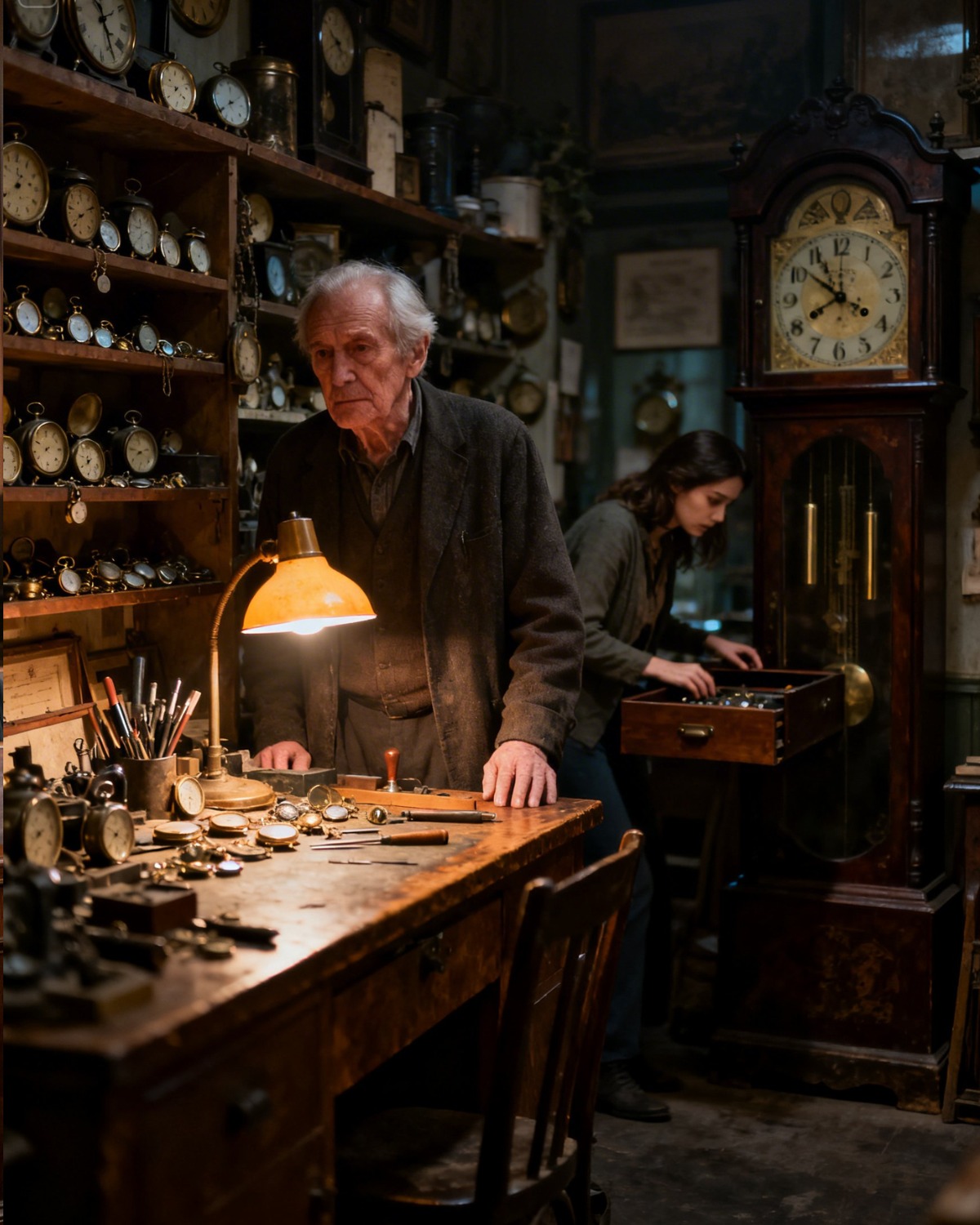
Placed the clock back on the shelf.
Wound it.
Listened to it begin again.
Tick.
Steady.
Certain.
Some mechanisms fail quietly.
Others… reveal themselves all at once.
But the important part isn’t the failure.
It’s what you do after.
That night, I stood there in the dim light of the workshop and understood something Miriam had known long before I did:
You can’t stop people from showing you who they are.
But you can prepare for the moment they do.
Part 4: What Remains After the Breaking
The legal process didn’t explode.
It dissolved.
That’s how most things end when the truth is too clear to fight.
There were no dramatic courtrooms. No raised voices. No last-minute reversals. Just paperwork moving from one desk to another, signatures replacing arguments, and people stepping back from something they could no longer control.
Within a week, Robert had done what he always did best—quiet, precise work that made noise unnecessary.
Courtney’s attorney sent a formal letter.
They were withdrawing from any involvement in the Lexington Avenue property.
No contest.
No negotiation.
Just distance.
Marcus followed through on the insurance issue. The employee who had been feeding Courtney information was reported, investigated, and terminated. There were consequences there too—quiet ones, but permanent.
As for Courtney…
She didn’t contact me.
Not once.
Which told me everything I needed to know.
Daniel filed for divorce in November.
He told me over coffee at the shop, standing at the front counter like he used to when he was fifteen.
“I thought it would be harder,” he said.
“It will be,” I replied.
He looked at me.
“I don’t mean legally,” he said. “I mean… emotionally.”
I nodded.
“That part takes time,” I said. “And it doesn’t follow a schedule.”
He gave a small, tired smile.
“I figured you’d say something like that.”
“I’ve had practice.”
He moved back into his old house.
Small place. Quiet street. The one he bought before he ever met her.
There’s something important about returning to a place that existed before something went wrong.
It reminds you who you were… before you started adjusting.
The first Sunday he came back to the shop, I didn’t say anything.
I just unlocked the door.
He stood there for a second, holding a paper bag from a bakery on Haywood.
“Brought pastries,” he said.
“Then you’d better come in,” I replied.
Continúa leyendo con «SIGUIENTE »»»