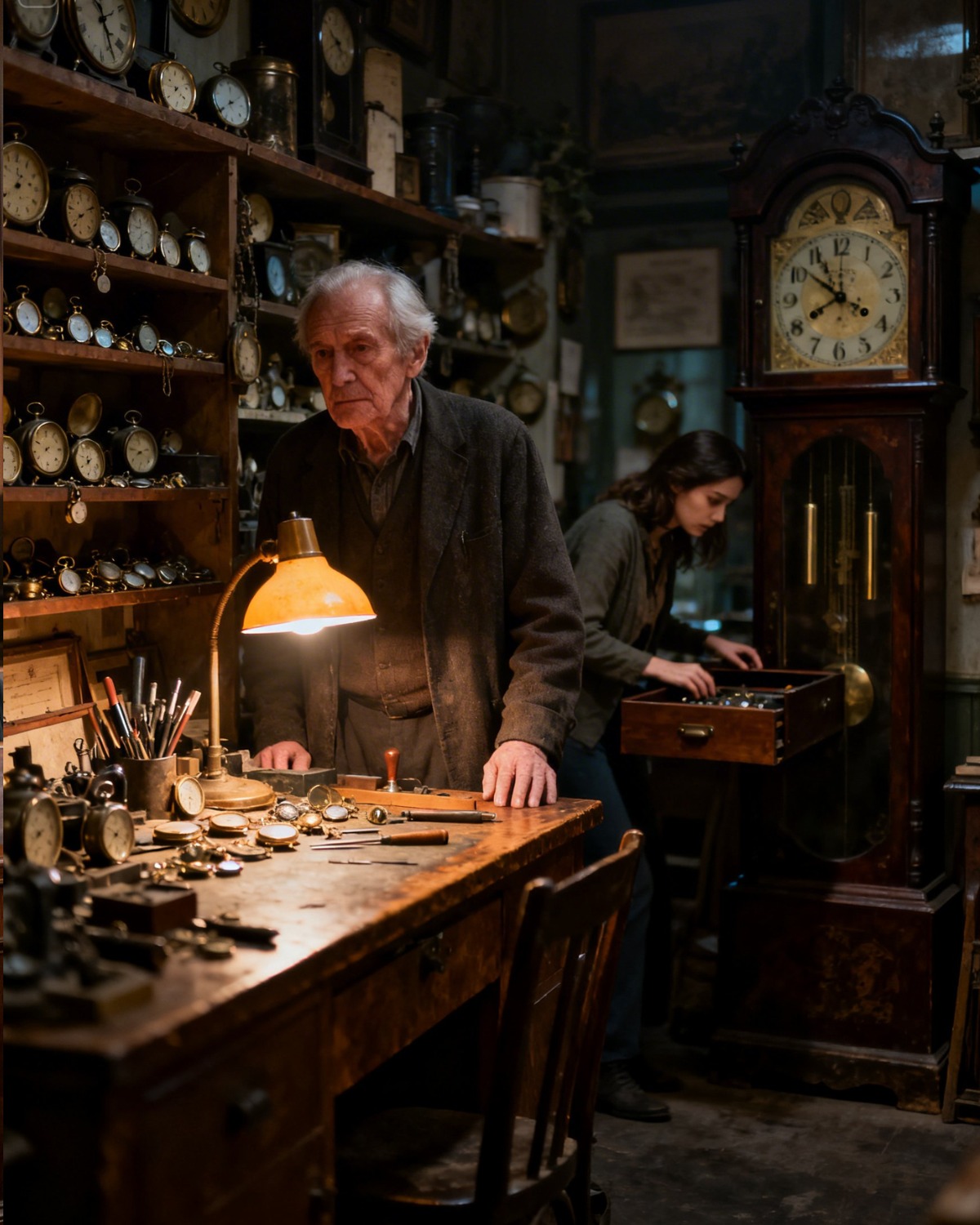
Part 1: The Quiet Between Ticks
There is a particular kind of quiet that settles over a watch repair shop after the last customer leaves.
It isn’t empty.
It isn’t peaceful.
It’s a waiting kind of quiet—like a held breath.
Every clock on every shelf is paused in its own way, even the ones still ticking. Waiting for hands. Waiting for attention. Waiting to matter again.
I’ve spent thirty-eight years learning the difference between a clock that simply stopped… and one that is dying.
Most people can’t hear it.
I can.
My name is Arthur Callaway. I’m sixty-four years old, and in Asheville, North Carolina, I’m known as the man who can bring time back.
My shop—Callaway Clock and Watch Repair—has been on Lexington Avenue since 1989. Same narrow brick storefront. Same gold-lettered window sign my wife painted by hand the year we opened.
Miriam took three days on those letters.
Gold leaf. Fine brush. No stencil.
She said if we were going to build something, it ought to look like it mattered.
I never changed that sign.
Never will.
Inside the shop, nothing is just inventory.
Every piece is a story that refused to end.
Pocket watches passed down three generations. Mantel clocks that survived house fires. Wristwatches brought in by people who don’t want to admit they’re holding onto the last thing someone left behind.
People think I fix machines.
What I really do… is hold onto time for people who aren’t ready to let it go.
The workshop is in the back, past a low wooden counter and a bead curtain Miriam bought at a craft fair in ’94.
She said it gave the place character.
I said it made me feel like I was walking into a fortune teller’s tent.
She laughed about that for a week.
That laugh… it stayed with me longer than anything else.
Miriam died eight years ago.
Ovarian cancer.
Stage four.
October to February.
Five months from diagnosis to goodbye.
She was fifty-seven. She had plans for sixty.
She left behind the shop, the ledgers, her gold leaf brush wrapped in cloth in the top drawer—and our son, Daniel.
He was twenty-six when she passed.
Already a good man.
That’s important to say now, before things get complicated.
Daniel was—and is—a good man.
The kind who shows up. The kind who remembers things. The kind who doesn’t measure love in transactions.
After Miriam died, he came every Sunday.
Didn’t matter what else was going on. He showed up.
We ate breakfast. Talked about small things. Big things. Nothing things.
He never once asked about money.
Never once asked about the will.
He just stayed.
I thought… maybe I got something right.
Two days before Miriam went into the hospital for the last time, she brought a clock into the shop.
An English bracket clock. Circa 1880. Fruitwood case, brass dial, Roman numerals—clean, deliberate, precise.
She had restored it herself.
That was unusual. Miriam was a bookkeeper, not a clockmaker.
But she’d spent three weekends on it.
Learning.
Trying.
Understanding.
She set it on the shelf above my workbench and looked at me in a way I didn’t fully understand at the time.
“This one stays here,” she said.
I smiled. Thought it was the medication talking.
“Alright,” I told her. “It’ll be safe.”
She held my gaze.
“And when the time comes,” she said quietly, “you’ll know what to do with it.”
I didn’t ask what she meant.
That was my mistake.
For years, that clock just sat there.
Running perfectly.
Miriam’s work always did.
I opened it once, out of curiosity. Looked at the movement. Clean. Balanced. Thoughtfully restored.
Then I closed it.
Didn’t think about it again.
Not really.
Not until much later.
Three years ago, Daniel met a woman named Courtney Baines.
They met at a fundraiser.
She worked in real estate development.
Thirty-one. Sharp. Composed. The kind of woman who looked like she knew exactly where she was going—and how to get there.
Daniel brought her to the shop one Saturday.
He was proud.
That kind of proud that comes from believing you’ve found something real.
She shook my hand with both of hers.
“Mr. Callaway, this place is absolutely charming.”
That’s what she said.
Charming.
I thanked her.
But I watched her eyes.
They weren’t seeing charm.
They were measuring.
I’d seen that look before.
Estate appraisers have it.
Probate attorneys have it.
People who walk into a room and don’t see what it is…
They see what it’s worth.
I noticed it.
Then I ignored it.
Because I wanted to be wrong.
They got engaged in December.
Married the following September.
Beautiful ceremony at a vineyard outside town.
Daniel cried when he saw her walking down the aisle.
So did I.
Miriam should have been there.
That’s all I could think about.
For a few months, everything seemed fine.
Courtney was attentive. Organized. Social in ways Daniel wasn’t.
She brought him out of his shell.
Or so I thought.
Then the questions started.
Small ones.
Casual.
“How long have you owned the building?”
“What’s property value like on Lexington these days?”
“Have you ever thought about retirement programs?”
She asked like someone curious.
But she already knew the answers.
She was checking mine.
I answered carefully.
Told her the building had been good to us.
Told her I hadn’t thought much about selling.
Told her the plan had always been to pass the shop to Daniel—if he wanted it.
She smiled.
“That’s so sweet.”
Sweet.
Thirty-eight years of work.
Sweet.
That was the first moment something shifted.
Daniel started changing after that.
Subtle at first.
Less present on Sundays.
Checking his phone more.
Answers that felt… rehearsed.
One morning I asked if everything was alright.
“Just tired,” he said.
Two weeks later, I asked again.
He hesitated.
“Courtney thinks I’ve been working too much,” he said. “She wants us to use weekends more intentionally.”
“Intentionally,” I repeated.
He nodded.
“Planned time. Activities.”
I understood what he wasn’t saying.
She was pulling him closer.
And pushing me out.
Slowly.
Deliberately.
Sundays became occasional.
Then rare.
Then gone.
Replaced by texts.
Texts aren’t the same.
We both knew it.
In April, my shop assistant—Gloria Simmons—pulled me aside.
She’s been with me eleven years.
When she calls me “Mr. Callaway,” I listen.
“Your daughter-in-law came in yesterday,” she said.
I hadn’t told her I’d be gone.
“She said she was just looking around. Nostalgia.”
Gloria paused.
“Then she went to the back.”
“How long?” I asked.
“Twelve minutes.”
I walked back there.
Nothing obvious was wrong.
But I know that shop like I know my own hands.
Things were off.
Slightly.
The invoice box shifted.
File drawer not fully closed.
Someone had been looking.
I didn’t confront Daniel.
Not yet.
Instead… I made a call.
Marcus Webb.
Former Buncombe County Sheriff’s deputy.
Private investigator now.
A customer had given me his card two years earlier.
I kept it.
Something about him struck me as… thorough.
We met after closing.
He listened.
Didn’t interrupt.
Didn’t speculate.
When I finished, he asked four questions.
Address of the property.
Access to my financial accounts.
Any direct requests about the will.
Whether I had legal representation.
I answered.
He nodded once.
“I’ll start Monday,” he said.
That same week, I called my attorney.
Robert Ashford.
Nineteen years.
Handled everything after Miriam passed.
We updated the will.
Restructured the trust.
Conditions instead of automatic transfer.
Protection instead of assumption.
He told me to document everything.
I told him I already was.
I bought a green notebook that afternoon.
Dated the first entry.
April 14th.
Three sentences.
It became a habit.
Then a record.
Then… a map.
Over the next two months, Marcus found exactly what I expected.
And exactly what I didn’t want to confirm.
Courtney had been meeting with a real estate attorney.
Not in an office.
In a café.
No paper trail.
Careful.
Three meetings.
Then phone calls.
Conversations about “timeline.”
About “transfer.”
About “positioning.”
She wasn’t wondering.
She was planning.
In June, I heard it myself.
I arrived early for a cookout at their house.
Came around the side gate.
Window open.
Her voice clear.
“I don’t know how much longer we’re talking,” she said. “He’s sixty-four. Blood pressure. Works alone.”
Pause.
“I’m being realistic.”
Another pause.
“Daniel knows we need to think about the future. He just needs time.”
I stood there thirty seconds.
Then I left.
Sat in my car.
Called Marcus.
“Document everything,” I said.
Two weeks later, he did.
A draft proposal.
Sale of my building.
Contingent on ownership transfer.
Contact listed?
Courtney.
Not Daniel.
That night, I sat in the shop in the dark.
Three hours.
Not angry.
Not even surprised.
Just… thinking.
About Miriam.
About what she said.
About that clock.
I stood up.
Walked to the shelf.
Took it down.
Opened the case.
Looked past the movement.
And that’s when I saw it.
Something I hadn’t noticed before.
A seam.
Too clean.
Too deliberate.
I pressed along the edge.
Felt resistance.
Then—
A click.
The bottom panel released.
A false floor.
Miriam had built it herself.
Inside was a plastic sleeve.
Folded paper.
Her handwriting.
I sat down.
And I read.
She had seen something.
Not proof.
But patterns.
Questions Courtney asked at the engagement dinner.
People she’d spoken to.
Quiet checks.
A prior transaction.
A dispute.
Nothing certain.
But enough to worry.
Enough to prepare.
Then she wrote something I will never forget.
“Arthur, you fix broken things. That’s your gift. But some things aren’t broken yet—they’re just going wrong. Watch for the signs. Protect what we built.”
I folded the letter.
Sat there a long time.
Then I placed it back inside the clock.
Closed the compartment.
And understood.
For the first time…
What she meant.
I didn’t act right away.
That’s the part people don’t understand.
You don’t move when you feel something.
You move when you can prove it.
So I waited.
Watched.
Recorded.
Prepared.
Eighteen months.
Every step.
Every shift.
Every word that didn’t belong.
Until the day came when my shop assistant called me again.
Her voice low.
“Mr. Callaway… you need to come see this.”
That was the moment everything changed.
Part 2: The Things People Think Are Hidden
Gloria didn’t raise her voice when she called me.
That’s how I knew it mattered.
“Mr. Callaway,” she said, barely above a whisper, “you need to come back here. Now.”
I was across town, finishing an on-site repair for a retired schoolteacher who refused to part with a grandfather clock that had outlived two husbands and a house fire. I told her I’d return the next day, packed my tools, and drove back faster than I should have.
When I stepped into the shop, the front was empty.
Lights on. Door locked.
Gloria stood just beyond the bead curtain, arms folded tight, like she was holding something in place inside herself.
“She’s here,” she said quietly.
I didn’t ask who.
I already knew.
We moved to the back slowly, not like people confronting a situation, but like people approaching something fragile that might break if handled wrong.
Gloria leaned closer.
“She said she needed the restroom,” she whispered. “That was fourteen minutes ago.”
Fourteen minutes.
Too long for anything honest.
I didn’t rush.
That’s another thing people misunderstand.
Rushing is what gives someone time to hide what they’re doing.
I stepped through the curtain like I did every day.
Same pace.
Same rhythm.
Same man.
Courtney was standing at my workbench.
Not startled.
Not flustered.
That told me everything.
She turned, holding my insurance file in her hands like she had every right to it.
“Oh—Arthur,” she said, smiling just a fraction too quickly. “I didn’t hear you come in.”
“I can see that,” I replied.
Her eyes flicked once—toward the filing cabinet.
Open.
Second drawer.
Exactly where Gloria said.
“I was just—” she began.
“Looking for something?” I finished.
She let out a soft laugh.
“I didn’t want to bother you. Daniel mentioned something about coverage, and I thought I could save you the trouble of digging through paperwork later.”
That’s how people like her do it.
They don’t lie outright.
They rearrange the truth until it sounds reasonable.
I stepped closer.
Slow.
Measured.
“And you thought the best way to do that,” I said, “was to go through my private files when I wasn’t here.”
Her smile didn’t disappear.
It adjusted.
“I didn’t realize it would be an issue,” she said. “We’re family.”
That word again.
Family.
Used like a key.
I stopped a few feet from the bench.
“Family doesn’t need to go through locked drawers,” I said.
A pause.
Barely a second.
But enough.
She closed the file gently and set it down.
“I think you’re misunderstanding my intentions.”
“No,” I said calmly. “I think I understand them very well.”
That was the first moment I saw it.
Not the charm.
Not the calculation.
The crack.
Small.
But real.
She left a minute later.
Didn’t argue.
Didn’t push.
Just gathered herself, smoothed her jacket, and walked out with that same composed posture she arrived with.
But she didn’t look at me again before she left.
That mattered.
Continúa leyendo con «SIGUIENTE »»»