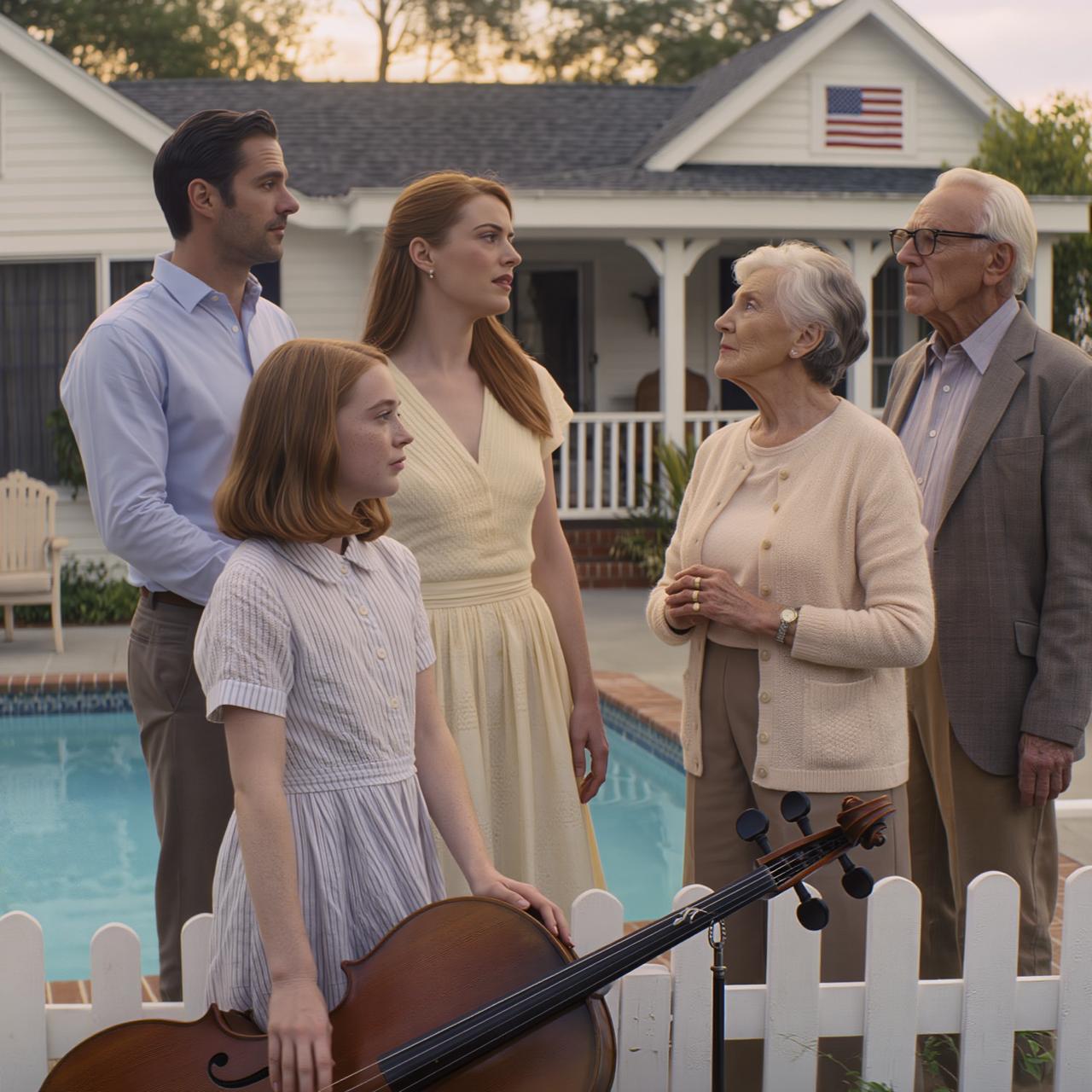
That night, back in our small two-bedroom apartment on the edge of town, Lucy practiced on the battered student cello her music teacher kept for emergency situations. The apartment complex was typical American middle-class housing with vinyl siding, a cracked basketball hoop in the parking lot, kids’ bikes leaning against railings. You could hear someone’s television through the thin walls, a baseball game humming in the background.
The student cello sounded like a cardboard box with strings attached.
Lucy didn’t complain once. She adjusted her posture carefully the way her great-grandmother had taught her, focused intensely, and tried again. Every single time the sound came out thin and wrong, she blinked hard like she was physically trying to hold something painful inside.
I stood in the doorway of her room pretending I was just casually watching, like this was normal, like my child hadn’t just been robbed of something precious.
“I can still practice,” she said finally, setting the bow down with exaggerated care. “It’s just harder with this one.”
“I know, sweetheart,” I said softly.
She nodded and stared down at her hands.
“Maybe Great-Grandma didn’t really mean for it to be mine yet,” she murmured quietly.
Something inside me went very still and cold.
Lucy had spent countless hours in that music room with my grandmother, her great-grandmother, learning in a way I could never teach her. Not because I didn’t love her enough, but because love doesn’t automatically come packaged with musical talent or knowledge.
My grandmother had that gift. Lucy had it too. It skipped right over me entirely. Like the universe looked at my family tree and decided not to put all the gifts in the same genetic basket.
Grandma used to sit beside Lucy during practice and correct her grip with just two gentle fingers and a meaningful look.
“Your left hand is talking too loudly,” she’d say with a slight smile.
It made Lucy giggle first, then fix the problem anyway.
Grandma praised her the way children genuinely need praising. Specific and honest.
“Better. That was much better.”
Not the empty kind of praise. Not the kind that says “good job” while the adult is still checking their phone and not really paying attention.
Lucy felt truly seen when she was with her great-grandmother in a house where she usually had to make herself smaller and quieter.
In my parents’ home, my sister’s kids Ben and Olivia could shout, spill juice everywhere, run through the hallway in their cartoon pajamas like tiny kings and queens holding court. It was always “adorable.” It was “kids being kids.” It was “they’re so spirited and full of life.”
Rachel, her husband, and their two children were living there temporarily. One of those family arrangements that was supposed to last a few months but had somehow grown roots and become permanent. Lucy, meanwhile, was expected to be quiet, polite, endlessly grateful for any attention. If she laughed too loudly, my mom would smile tightly and say “inside voice, sweetheart” in that tone that didn’t reach her eyes. If Ben yelled at the top of his lungs, my dad would laugh heartily and say “he’s got strong lungs on him.” If Olivia demanded immediate attention, Rachel would scoop her up like she was a tiny celebrity deserving of worship.
If Lucy needed anything at all, anything whatsoever, it was treated like an inconvenience.
Lucy learned to take up less space the way other children learn basic math facts.
My grandmother noticed this dynamic. She didn’t always intervene directly because she was still my mom’s mom, and family politics are their own kind of dangerous minefield. But she did something quieter and more meaningful.
She carved out a protected space where Lucy didn’t have to apologize for simply existing.
That space was the music room.
It made practical sense too. My apartment wasn’t designed for antique instruments and long practice sessions. It was safe, clean, and mine, but definitely small. Sound carried easily through the walls. Neighbors complained about noise. And a cello like my grandmother’s, now Lucy’s, wasn’t something you could just leave in a corner near the radiator and hope for the best.
So we stored it there safely, in that carefully climate-controlled room, in the locked cabinet with the little humidifier running like a quiet promise.
My grandmother had been extremely careful about everything. Not just emotionally careful, but legally careful with proper paperwork. She’d had the cello professionally appraised, photographed from every angle, documented thoroughly. She’d shown me the complete file once, not because she wanted to brag, but because she wanted me to fully understand the situation.
“This is not just sentimental value,” she’d said seriously, tapping the papers. “It’s genuinely valuable. People get strange and unpredictable around valuable things.”
I’d nodded at the time, because yes, people definitely get strange around valuable things. I just never imagined that “people” would mean my own parents.
My grandmother had moved out of my parents’ house less than a week before all this happened, into an assisted independent living community my mom described enthusiastically as “perfect for her” and “so much safer” and “so much less stressful for everyone.” That might have been genuinely true for my grandmother’s wellbeing. It was definitely true for my mom’s convenience. The move had been preceded by months of pointed comments like “this living situation is getting really hard” and “she needs professional care now” and “it’s not fair to expect all of us to manage this.”
“All of us” meaning my mom, my dad, Rachel, and somehow never including me, the one who actually showed up consistently to help.
Grandma didn’t leave kicking and screaming in protest. She left the way she did everything important in life, with a straight spine and a quiet, dignified decision. But once she was gone from the house, the entire energy shifted noticeably.
The last set of eyes that really mattered had left the building.
And my family did what they always do when no one can actually stop them.
They took what they wanted.
Grandmother’s Response
Lucy went to bed early that night. She didn’t ask to call my grandmother. She didn’t ask permission to complain about the situation. She just hugged me tightly before she fell asleep, like she was physically holding herself together using my presence.
Continúa leyendo con «SIGUIENTE »»»