Part 1
When the sledgehammer finally broke through the plaster, the air that rushed out wasn’t just stale.
It carried something older. Something sealed.
Arthur Pendleton staggered back, coughing as the cloud of chalky dust engulfed him, but even through the grit scraping his throat, he could smell it—cold metal, oil, and something faintly electric, like the aftertaste of lightning. It didn’t belong in a decaying Victorian house that hadn’t seen proper maintenance in decades.
It felt wrong.
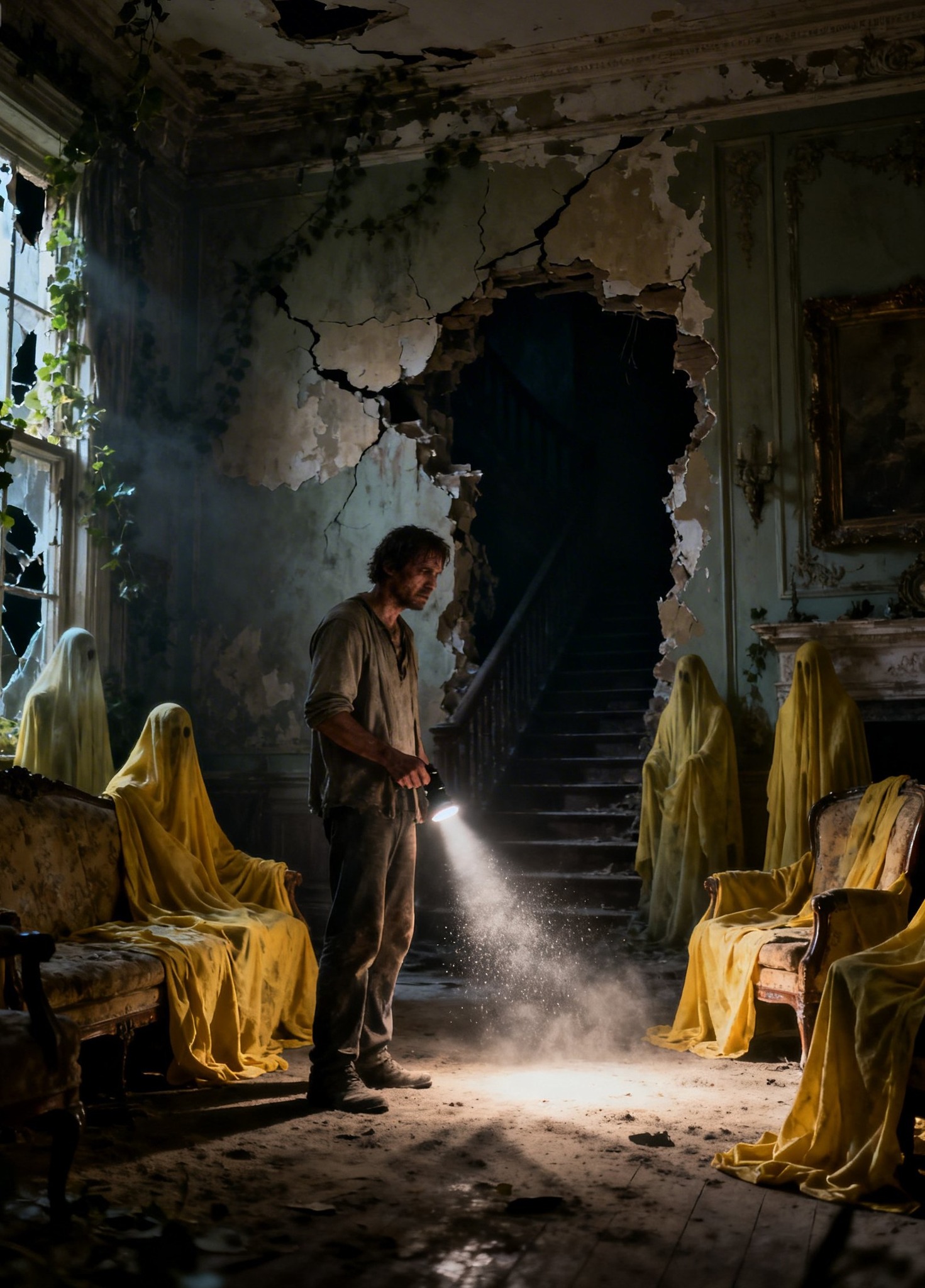
For a long second, Arthur just stood there in the ruined library, chest heaving, sledgehammer hanging limp in his blistered hands. Sweat mixed with plaster dust on his skin, turning him into something ghostly and pale under the narrow beam of his flashlight.
Then he leaned forward.
The jagged hole in the wall wasn’t deep. Not at first glance. But beyond the splintered lath and crumbling plaster, the darkness wasn’t the soft, dusty black of an empty cavity.
It was dense.
Structured.
Deliberate.
Arthur raised his flashlight with trembling fingers and aimed it through the opening.
The beam cut across steel.
Not rusted. Not corroded. Perfectly intact.
A reinforced door stood just beyond the broken wall, its matte surface absorbing the light. The edges were thick, industrial, built to withstand something far worse than time. It was slightly ajar, as if someone had stepped through it… and never come back.
Arthur’s pulse began to pound.
“This isn’t real,” he muttered.
But it was.
And suddenly, everything about Silas Blackwood—the paranoia, the vanished fortune, the abandoned estate—shifted into something far more dangerous than eccentricity.
Arthur swallowed hard.
Then he stepped through the broken wall.
Four days earlier, Arthur Pendleton had been sitting in his cramped Chicago apartment, staring at a stack of unpaid bills that had begun to feel less like paperwork and more like a verdict.
Final notice.
Urgent.
Action required.
The phrases blurred together.
His coffee had gone cold hours ago, untouched, as he tried to figure out how a high school history teacher ended up buried under a mountain of debt that wasn’t even his.
His mother’s.
Late-stage cancer didn’t just take people. It hollowed out everything around them. Savings accounts. Retirement funds. Hope.
Arthur had done what he could. Which, in the end, wasn’t enough.
Now he lived in a shrinking world of overdue notices and unanswered calls, measuring his life in minimum payments and quiet dread.
So when the envelope arrived—thick, cream-colored, with the embossed letterhead of a New York law firm—he almost didn’t open it.
He assumed it was another demand.
Instead, it was an inheritance.
The Zoom call had been brief and clinical.
Clara Hughes appeared on screen with the composed efficiency of someone who had delivered both fortunes and disappointments many times before.
“Mr. Pendleton,” she said, adjusting her glasses, “you are the sole surviving heir of Silas Blackwood.”
Arthur blinked.
“I don’t know who that is.”
“A distant relative. Your great-uncle.”
That didn’t help.
Clara continued anyway.
“He passed away last month at the age of ninety-one. His estate, such as it is, has been transferred to you.”
Arthur leaned forward slightly.
“What does that include?”
“A property in the Hudson Valley. Blackwood Manor.”
The word manor hit him harder than it should have.
For a brief, dangerous moment, hope flickered.
“Is it… worth anything?”
Clara’s expression softened—but only just.
“The property has been abandoned for over twenty years. It is in severe disrepair and has been condemned by the county. There are approximately eighty thousand dollars in back taxes owed.”
The hope died instantly.
“You have thirty days,” she added, “to remove any personal belongings or contest the seizure. After that, the state will take possession and demolish the structure.”
Arthur leaned back in his chair, exhaling slowly.
“So… you’re telling me I inherited a collapsing house and a tax bill.”
“Yes.”
There was no sugarcoating it.
Still… something lingered.
“Was there anything else?” he asked.
Clara hesitated, just slightly.
“Mr. Blackwood liquidated most of his assets decades ago. There is no record of remaining financial holdings.”
Arthur nodded.
Of course there wasn’t.
He almost didn’t go.
It would’ve been easier to ignore it. Let the state bulldoze the place and move on with his already unraveling life.
But desperation has a way of turning chores into opportunities.
If there was anything left—antique furniture, rare books, even old silver—he might be able to scrape together enough money to breathe again.
So he packed what little he owned into his aging Honda Civic and drove east.
Blackwood Manor didn’t look abandoned.
It looked forgotten.
The dirt road leading up to it was barely visible beneath years of overgrowth, branches clawing at the sides of his car as if trying to turn him back.
When the house finally came into view, Arthur slowed instinctively.
It towered over the landscape like a monument to something long dead.
The slate roof sagged in places, missing shingles like broken teeth. Windows were boarded up, dark and sightless. Ivy wrapped around the structure in thick, choking strands.
It wasn’t just decaying.
It felt… sealed.
Arthur killed the engine and sat there for a moment, listening to the quiet.
No birds.
No wind.
Just stillness.
“Great,” he muttered. “Perfect.”
He grabbed his tools, stepped out of the car, and approached the front door.
The padlock snapped easily under the bolt cutters.
The door creaked open with a long, hollow groan.
And the smell hit him immediately.
Rot. Dust. Time.
Arthur stepped inside.
The first three days passed in a blur of work.
Room after room, drawer after drawer—nothing of real value.
It was as if the house had been picked clean long ago.
The furniture was covered in yellowed sheets, the wood beneath warped and cracked. Books crumbled at the touch. Even the silverware—what little remained—was tarnished beyond recognition.
Arthur grew more frustrated with each passing hour.
“This is pointless,” he muttered on the third night, sitting on the staircase with a protein bar and a bottle of lukewarm water.
But on the fourth day, everything changed.
The library was on the second floor.
Arthur hadn’t saved it for last intentionally—it just happened that way.
The door stuck when he tried to open it, swollen from years of humidity. He had to shoulder it twice before it gave way with a sharp crack.
Inside, chaos.
Books torn apart.
Pages scattered.
Furniture overturned.
It didn’t look abandoned.
It looked searched.
Arthur stepped carefully through the debris, his eyes scanning the room.
“What happened here…?” he murmured.
Then he saw the desk.
Unlike everything else, it hadn’t been completely destroyed—just buried under stacks of leather-bound ledgers.
Arthur brushed away the dust and opened one.
And everything shifted.
These weren’t personal journals.
They were records.
Precise. Detailed. Obsessive.
Industrial purchases. Construction materials. Equipment deliveries.
Arthur frowned as he flipped through the pages.
“Bessemer steel supports… diesel generators… ventilation systems…”
His brow furrowed deeper.
This wasn’t the record of a man going bankrupt.
This was the record of someone building something.
Something expensive.
Something hidden.
Arthur turned to the final page.
The handwriting had changed—less controlled, more frantic.
They are circling.
The hounds have caught the scent.
The gallery is sealed.
Let them think I am a fool.
The hollow wall will hold the truth.
Arthur stared at the words, his pulse quickening.
“The hollow wall…”
He looked up slowly.
And that was when everything began to fall into place.
Now, standing in the ruined library with a broken wall in front of him and a hidden steel door beyond it, Arthur realized just how right he had been to follow his instincts.
And how wrong he had been to think this was just about money.
He stepped closer to the door.
It was cold.
Solid.
Real.
He placed his hand against it and pushed.
It moved.
Just enough to reveal the darkness beyond.
And the staircase.
Spiraling down.
Deep.
Far deeper than the house should allow.
Arthur hesitated.
Every instinct told him to stop.
To walk away.
To leave the house, get in his car, and forget he had ever come here.
But another voice—quieter, sharper—cut through the fear.
You have nothing left to lose.
Arthur exhaled slowly.
Then he reached into his bag, pulled out his flashlight, and stepped through the doorway.
The temperature dropped immediately.
The air changed.
Cleaner. Colder.
Manufactured.
Arthur placed his foot on the first iron step.
It groaned softly under his weight.
He swallowed.
Then began to descend.
He counted without meaning to.
Ten steps.
Twenty.
Thirty.
The light from above faded quickly, swallowed by the darkness below.
By the time he reached the bottom, the house above felt like another world.
The staircase ended at a platform.
In front of him stood another door.
Bigger.
Heavier.
A vault.
Arthur stared at it, his heart pounding in his ears.
“Okay…” he whispered.
He stepped forward.
Placed his hand on the cold steel.
And pushed.
The door opened with a low, grinding sound.
Darkness waited on the other side.
But this time, it wasn’t empty.
Arthur stepped inside.
And everything changed.
Part 2
Arthur stepped across the threshold of the vault and felt the weight of the world above him vanish.
Not metaphorically.
Physically.
The air itself was different down here—cool, dry, and unnervingly clean. Gone was the suffocating rot of the manor. In its place lingered a sterile sharpness, tinged with oil and ozone, like a machine that had been waiting… patiently.
His boots echoed against the concrete floor.
The sound carried.
Too far.
Arthur lifted his flashlight, sweeping the beam across the darkness.
At first, it revealed nothing but empty space—vast and unnatural beneath a house that should barely have had a crawl space. Then the edges began to form. Steel. Reinforced walls. Pipes running along the ceiling in rigid, deliberate lines.
This wasn’t a basement.
It was a bunker.
And it was enormous.
“What the hell did you build, Silas…?” Arthur whispered.
His voice sounded small.
The beam of his flashlight drifted left—and stopped.
A machine.
Massive. Industrial. Olive green.
Arthur stepped closer, his breath catching.
A diesel generator.
Not a hobbyist setup. Not something salvaged. This was commercial-grade—heavy-duty, built to power something far more demanding than a house.
He turned slowly, taking in the rest.
A breaker panel.
Rows of overhead fluorescent lights.
A long mahogany table in the center of the room, absurdly elegant against the stark brutality of concrete and steel.
And along the far wall—
Safes.
Six of them.
Towering, steel-bodied, each with a rotary dial.
Arthur lowered the flashlight slightly, his mind struggling to keep up.
“This… this isn’t paranoia,” he murmured.
It was preparation.
Deliberate. Calculated. Funded.
Which meant one thing.
Silas Blackwood hadn’t lost his fortune.
He had spent it.
Arthur approached the breaker panel slowly.
The switch was heavy, industrial, worn smooth by use.
Or… repeated testing.
He hesitated.
There was something sacred about the darkness. Like flipping the switch would break a seal that had been in place for decades.
But curiosity won.
It always did.
Arthur gripped the lever and pushed.
For a moment, nothing happened.
Then—
A low rumble.
The generator coughed once.
Twice.
And then it roared to life.
The sound filled the bunker, vibrating through the floor, through Arthur’s bones, until it became a steady, powerful hum.
Overhead, the fluorescent lights flickered—
Once.
Twice.
Then snapped fully on.
Arthur flinched, raising an arm against the sudden brightness.
And when his eyes adjusted—
He froze.
The bunker wasn’t empty.
It was organized.
Meticulously.
The mahogany table was covered in documents, stacked in precise piles. The safes stood like silent sentinels along the wall. But it was the far end of the room that held Arthur’s attention.
A wall of corkboard.
Covered.
Not decorated—covered.
Newspaper clippings.
Photographs.
Documents.
All pinned and connected by lengths of red yarn, crisscrossing in a chaotic web.
Arthur took a slow step forward.
Then another.
His pulse quickened with each movement.
“This isn’t real,” he whispered again—but this time, it wasn’t disbelief.
It was dread.
He reached the board.
The first clipping he read was yellowed with age.
“Apex Holdings Announces Major Infrastructure Expansion”
Arthur frowned.
Apex Holdings.
The name meant nothing to him.
He scanned further.
More articles.
Corporate acquisitions.
Real estate developments.
Partnerships.
Always the same name.
Apex Holdings.
And in several photographs—
A man.
Young. Sharp suit. Confident smile.
Arthur leaned closer.
Something about the face bothered him.
Then it clicked.
He had seen that man before.
Not in person.
But recently.
Very recently.
Arthur’s stomach tightened.
“Richard Abernathy…” he whispered.
The realization hit him like a punch to the chest.
The man who had shown up at the manor.
The man who had offered him two hundred thousand dollars.
The man who had lied.
Arthur stepped back, his eyes scanning the rest of the board with new urgency.
The red yarn connected the photos to documents—bank transfers, engineering reports, legal filings.
One document caught his eye.
He pulled it free.
A photocopy.
A structural analysis.
His brow furrowed as he read.
Then his blood ran cold.
The document detailed a dam project.
Location: Hudson Valley.
Developer: Apex Holdings.
At first, it read like standard engineering language—load tolerances, stress factors, material specifications.
But then—
Handwritten notes.
In red ink.
Substandard reinforcement.
Critical failure risk under sustained pressure.
Recommendation: halt construction.
And beneath that—
A stamped word.
DENIED
Arthur’s hands trembled.
He flipped to another document.
More notes.
More warnings.
More denials.
All tied back to Apex Holdings.
All ignored.
“All to save money…” Arthur whispered.
His gaze drifted back to the corkboard.
This wasn’t a collection.
It was an investigation.
Silas Blackwood hadn’t gone mad.
He had uncovered something.
Something big enough to destroy a company.
Something big enough to make powerful people nervous.
Something big enough—
To make them come looking.
Continúa leyendo con «SIGUIENTE »»»