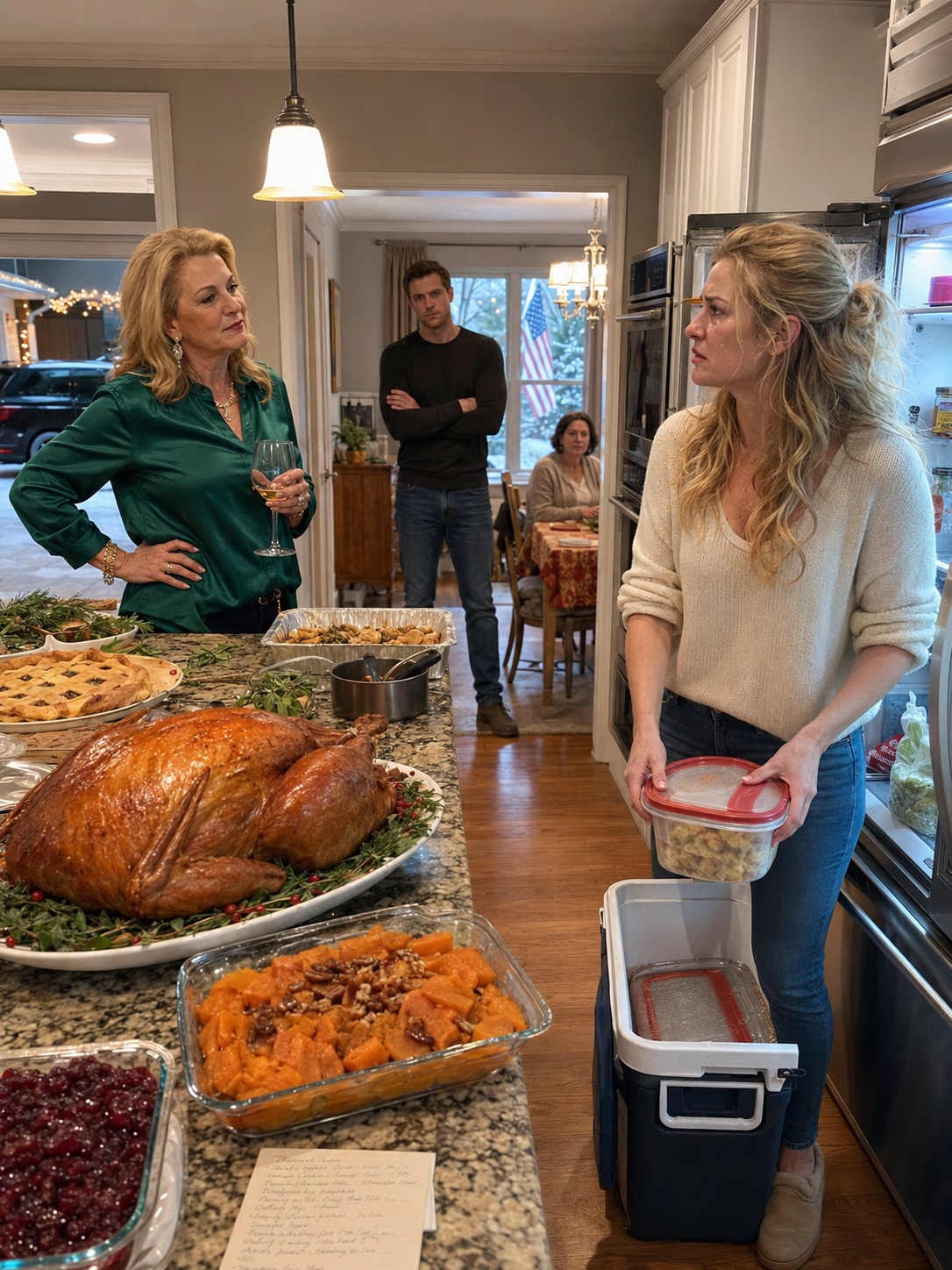
He was grieving.
Not his mother exactly.
The version of his mother he wished existed.
The one who could love him without controlling him.
The one who could welcome me without competing with me.
The one who could sit at our table as a guest instead of trying to become the host.
I did not gloat.
I had won my kitchen, not a war.
And winning a boundary often comes with grief.
Fourteen months passed.
Brandon and I stayed in counseling, first weekly, then twice a month, then monthly.
We started talking about children again, carefully.
This time, the conversation included boundaries.
If we had a baby, Karen would not be in the delivery room.
If we hosted birthdays, we controlled the guest list.
If holidays became too much, we would rotate or stay home.
No surprise visits.
No guilt invitations.
No “but family” used as a weapon.
Brandon agreed to all of it.
More importantly, he practiced it.
A marriage is not repaired by one dramatic speech.
It is repaired in small moments repeated until trust has somewhere to stand.
The next Thanksgiving, I hosted again.
Ten people.
Me and Brandon.
My parents.
Tyler and his new girlfriend, Megan.
Lisa and James.
And Karen.
Yes.
Karen.
People are complicated.
Boundaries are not the same as banishment.
She arrived at four o’clock exactly because that was the time I set.
She brought a pumpkin pie.
Homemade.
Actually homemade.
I know because there was flour on the bottom of the pie plate and a tiny burn on one edge of the crust.
She handed it to me in the kitchen.
“I made this,” she said.
“I can see that.”
There was an awkward pause.
Then she said, “Your turkey smells wonderful.”
I waited.
For almost.
For but.
For Richard’s mother.
None came.
“Thank you,” I said.
Dinner was calm.
Not perfect.
Karen still told Brandon he looked thin.
She still made a comment about how she would have chosen a warmer paint color for the dining room.
But when she began to say, “Maybe next year we could invite Linda’s whole family—”
Brandon set down his fork.
“That’s Ashley’s call, Mom. It’s her kitchen.”
The room went still.
Karen looked at him.
Then at me.
For a second, I saw the old Karen rise behind her eyes, ready to argue, guilt, push, twist.
Then she swallowed it.
“Of course,” she said.
Two words.
Small words.
But they landed heavier than an apology.
After dinner, she helped clear plates.
Not by taking over.
Not by rearranging my cabinets.
She asked, “Where would you like these?”
That was new.
When she left, she hugged Brandon first.
Then she turned to me.
The hug she gave me was brief. Careful. Awkward.
But real enough.
“Thank you for dinner,” she said.
“You’re welcome.”
After she left, Brandon and I stood in the kitchen together.
The counters were messy. The dishwasher was running. Half a pie sat on the island. The house smelled like turkey, coffee, and candle smoke.
Brandon wrapped his arms around me from behind.
“I’m sorry it took me so long,” he said.
I leaned back against him.
“Me too.”
“I won’t let it happen again.”
“I know.”
And I did.
Not because he said it.
Because he had spent the last year proving it.
Sometimes people ask if I regret what I did that Thanksgiving night.
The answer is complicated.
I regret waiting so long.
I regret swallowing my anger until it became a weapon.
I regret that innocent relatives got dragged into Karen’s power play.
I regret that my marriage had to nearly crack open before Brandon saw the load he had placed on me.
But do I regret taking the food?
No.
Not once.
That food was mine.
That kitchen was mine.
That holiday labor was mine.
And when someone tried to claim ownership of all three, I removed them from her reach.
People love to say family means sacrifice.
Usually, they say it to the person already sacrificing the most.
They say holidays are about keeping the peace.
But peace without respect is just silence with better decorations.
They say a good wife adapts.
Smiles.
Makes room.
Feeds everyone.
Forgives quickly.
Doesn’t make a scene.
But I have stood in a kitchen at eleven o’clock at night while another woman held my wine, changed my dinner time, claimed my home, and waited for my husband to do nothing.
I know what that kind of peace costs.
It costs $347.
It costs eleven hours on your feet.
It costs years of swallowed comments.
It costs the belief that your kindness will eventually be recognized.
It costs pieces of yourself so small you don’t notice them missing until one night you open the refrigerator and realize there is almost nothing left of you.
So yes, I took back the turkey.
I took back the pies.
I took back the cranberry sauce, the potatoes, the ham, the butter, the cream, and every dish I had prepared with hands that were tired of serving people who did not respect me.
But more than that, I took back my home.
My marriage.
My voice.
My kitchen.
And I never apologized for the Thanksgiving I reclaimed.
Porque a veces la frase más importante de tu vida no es larga.
A veces no es elegante.
A veces, son cinco palabras pronunciadas en una cocina tranquila, con el refrigerador vacío a tus espaldas, y tu dignidad finalmente se yergue en tu pecho.
Ahora te toca dar de comer a tus invitados.
PARTE 6 — LA NAVIDAD QUE KAREN INTENTÓ ROBAR
Durante las tres semanas posteriores a aquel segundo Día de Acción de Gracias, casi creí que habíamos superado lo peor.
Ese es el peligro de la paz después de la tormenta.
Se siente permanente.
Se siente merecido.
Parece que el cielo no podría oscurecerse de nuevo porque ya has sobrevivido a suficientes truenos para toda una vida.
Karen fue educada durante todo diciembre.
No está caliente.
No es fácil.
Educado.
Llamó antes de venir. Envió un mensaje de texto en vez de pasar por casa. Preguntó si estábamos libres antes de invitarnos a cenar. Incluso me mandó una foto de una receta de pan de calabaza y escribió: “¿Crees que esto estaría bien para la mañana de Navidad?”.
Era un mensaje tan normal que me quedé mirándolo durante un minuto entero.
Luego se lo mostré a Brandon.
Estaba sentado en la isla de la cocina, con el portátil abierto, revisando los planos de la casa de un cliente que se construiría junto al lago.
—¿Esto es una trampa? —pregunté.
Miró mi teléfono.
Su boca se contrajo.
“¿Con mamá? Podría ser pan. Podría ser la guerra.”
“Útil.”
Cerró el portátil y me cogió de la mano.
“Hablaré con ella.”
Retiré la mano suavemente.
—No —dije—. Yo responderé. Ella me lo preguntó.
Eso también era nuevo.
Antes de la terapia, todo lo relacionado con Karen se sentía como un campo de batalla donde Brandon tenía que interponerse entre nosotras porque no podía confiar en que me apoyara. Pero durante el último año, algo cambió. Ya no necesitaba que él controlara cada conversación.
Necesitaba que me respaldara si la conversación cruzaba ciertos límites.
Hay una diferencia.
Entonces escribí:
Tiene buena pinta. Quizás podrías añadirle ralladura de naranja. ¿Piensas prepararlo?
Karen respondió diez minutos después.
Pensé en llevarlo la mañana de Navidad, si tú y Brandon todavía vais a ofrecer el desayuno.
Continúa leyendo con «SIGUIENTE »»»