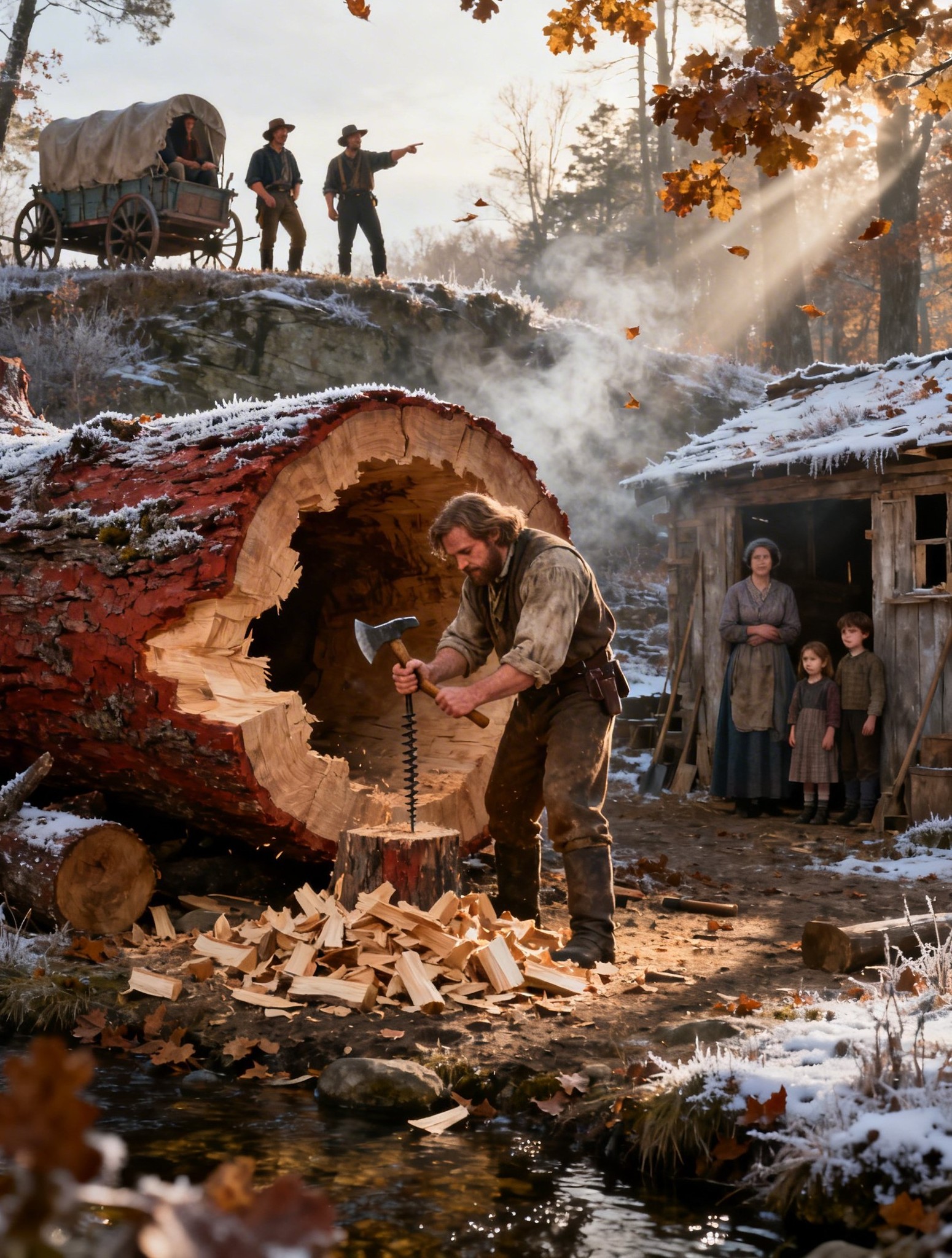
The Change Started Spreading Immediately
That’s what no one expected.
Not slow adoption.
Not debate.
Immediate replication.
Because once men feel the difference in their own bodies—
They stop arguing.
Foremen began rebuilding sections of camps overnight.
Not perfectly.
But correctly.
And the result was immediate.
Less firewood.
Less sickness.
More sleep.
More work.
Less dying.
But Something Else Was Happening Too
People were talking.
Not just about the buildings.
About me.
About the “Swede who built silence.”
Some said it like respect.
Some said it like fear.
And a few—
Like resentment.
Because nothing makes a man more uncomfortable than realizing survival was never about strength.
It was about understanding something he never thought mattered.
And Then the Real Test Came
A second storm.
Worse than the first.
The kind that flattens expectation.
Wind that didn’t just move across the land—
It attacked it.
And every man in those camps had to decide:
Go back to old ways…
Or trust what they didn’t fully understand.
And Rourke made a decision that would define everything that came after.
He came back to my log that night.
Not alone.
And what he said changed everything.
Part 5: The Night the Wind Finally Lost
The second storm didn’t arrive like weather.
It arrived like punishment.
By dusk, the sky had turned the color of old iron. The kind of gray that doesn’t reflect light so much as swallow it. Snow came in thick, aggressive sheets, driven sideways by a wind that sounded like it had weight behind it.
Not air.
Force.
The kind that tests everything man thinks he built.
And for the first time since I arrived in Pennsylvania—
Even I paused.
Rourke Came Back With Men Behind Him
He didn’t come alone.
That was the first sign something was different.
Three wagons behind him. Foremen. Workers. Men who had seen enough suffering in their bunkhouses to stop believing stubborn pride was a survival strategy.
They stepped out into the storm like men walking into judgment.
Rourke didn’t waste words.
“We’re not waiting for it to kill us,” he said.
Then he looked at me.
“We do it your way. Now.”
We Worked Through the Night
There’s a kind of cold that makes time irrelevant.
Your hands stop being yours.
Your breath becomes something you notice more than feel.
And the world shrinks to the next thing that needs fixing before it fails.
We sealed gaps.
Raised walls.
Packed earth.
Reworked joints.
Every man moved like he understood—finally—that the enemy wasn’t the storm outside.
It was the invisible movement inside.
The air that refused to stay still.
Rourke Broke First
Not physically.
Mentally.
I saw it happen while we were sealing the last bunkhouse.
He stopped mid-motion.
Just stood there.
Watching a candle I had set on a crate.
The flame didn’t flicker.
Not once.
Outside, the wind hit the structure like a living thing trying to get in.
Inside, nothing responded.
Rourke exhaled slowly.
“This whole time…” he muttered.
I didn’t answer.
He turned to me.
“You weren’t fighting winter.”
I shook my head.
“No.”
He swallowed hard.
“You were stopping it from moving inside.”
“Yes.”
That’s when something in him finally gave up resisting.
The System Changed Overnight
By morning, it wasn’t theory anymore.
It was practice.
Every camp that had seen the demonstration began rebuilding.
Not gradually.
Not cautiously.
Rapidly.
Because suffering has a way of accelerating belief.
Especially when relief is visible.
The Difference Was Immediate
Men who had been sick stopped worsening.
Men who couldn’t sleep finally slept.
Wood consumption dropped so sharply it confused the camp accountants.
But the most noticeable change wasn’t physical.
It was psychological.
The men stopped bracing for impact all the time.
Their bodies relaxed in ways they hadn’t in months.
Because for the first time—
The environment wasn’t leaking into them.
And Then They Came to My Log Again
Rourke came alone this time.
No authority. No pride. No performance.
Just him.
He stood outside for a long time before entering.
When he finally stepped inside, he didn’t speak immediately.
He just looked around.
At the still candle.
At the sleeping children.
At Elin, quietly mending cloth like nothing in the world was wrong.
Then he said something I didn’t expect.
“I told them it was skill,” he said quietly.
I watched him.
He shook his head.
“But it wasn’t just skill.”
I nodded once.
“No.”
He looked at me directly.
“It was understanding something the rest of us ignored.”
“Yes.”
A long silence followed.
Then he added:
“You’re going to change how people build things.”
I didn’t answer right away.
Because I wasn’t thinking about buildings anymore.
I was thinking about how many people had suffered because they believed fire was stronger than wind.
The Final Storm Passed Like It Had Lost Interest
The wind didn’t stop suddenly.
It faded.
Like something that realizes it’s no longer effective.
By the time the skies cleared, the plateau looked different.
Not physically.
Structurally.
Camps that had been death traps were now livable.
Men who had been exhausted were now functional.
And the idea that suffering was “normal” in winter…
It didn’t survive.
Spring Came Quietly
When thaw finally arrived, no one celebrated loudly.
Because something had changed in how they saw cold.
It wasn’t an enemy anymore.
It was a condition.
Something you could design against.
Something you could understand.
Something you could win without brute force.
The Last Time I Saw Rourke
He came one final time before I left for the deeper forests again.
He didn’t bring complaints.
Or questions.
Just respect.
He stood outside my log and said:
“I spent my whole life building against winter.”
I nodded.
He continued:
“And I was building it wrong.”
That was the closest he ever came to apology.
I accepted it without comment.
Because it wasn’t about forgiveness.
It was about understanding arriving late—but still arriving.
What I Built Was Never Just a Cabin
It was never about wood.
Or trees.
Or construction.
It was about something far simpler.
And far more dangerous to ignore:
Still air holds heat.
Moving air steals it.
Everything else is just detail.
The Lesson They Carried Forward
I never stayed in one place long after that.
But the idea traveled faster than I did.
Logging camps rebuilt.
Families changed how they sealed homes.
Men who once mocked tight construction now swore by it.
Not because I convinced them.
But because winter did.
Final Reflection
People think survival is about strength.
But strength is loud.
It burns fuel.
It fights constantly.
It exhausts itself.
What actually keeps you alive is control over what you don’t see.
Air.
Movement.
Loss.
And the man they called foolish—
Built a home where none of those things could enter.
Not by fighting the storm.
But by removing its ability to move.
The wind never stopped being strong.
It just stopped being allowed inside.
And that made all the difference.
THE END