Lucy let out a breath I hadn’t realized she’d been holding for six entire weeks.
And I realized something profound too.
My parents weren’t pale because my grandmother had found out the truth. They were pale because she’d finally done the one thing my family couldn’t survive.
She’d stopped letting them pretend.
Justice and Healing
Lucy got her cello back.
It arrived the very next day in a hard protective case that looked like it had traveled through several questionable hands. Andrew delivered it himself, carefully wheeling it up the stairs to my apartment like it was a fragile, precious guest.
My grandmother came too.
She opened the case with Lucy like it was a sacred ceremony.
Lucy ran her fingers over the polished wood like she was touching something alive and breathing.
She didn’t say much at all. She just hugged my grandmother so tightly that I saw my grandmother close her eyes for a long second, like she was finally letting herself feel everything now that the danger had passed.
My parents, meanwhile, discovered an unpleasant fact about selling things you don’t legally own.
People want their money back.
The buyer came after them exactly the way you’d expect. Angry, embarrassed, and absolutely not interested in my mom’s “we didn’t know” excuses. The phrase “repayment plan” entered my parents’ vocabulary like an unwelcome disease.
They couldn’t pay it all back at once. Most people can’t, especially not people who pour stolen money into concrete and chlorine.
Sixty days went faster than they thought possible.
My mom tried bargaining. My dad tried guilt. Rachel tried rage and accusations.
My grandmother didn’t move an inch.
They packed up their life in a house they’d treated like it was theirs and moved into something smaller, something cheaper, something without a swimming pool. Rachel and her husband didn’t end up helping my parents financially, not because they couldn’t afford it, but because they wouldn’t.
Rachel suddenly remembered how to distance herself when real consequences showed up.
One minute it was “we all agreed to this plan.”
The next minute it was “I told you this was a bad idea from the start.”
Families like mine have a special talent for rewriting history on the fly.
Ben and Olivia adjusted to the change. Children always do eventually.
Lucy adjusted too, but in a completely different way.
She started speaking up more confidently.
Small things at first.
“Actually, I was sitting there first.”
“I don’t like that joke.”
“No, I’m not okay with that.”
The first time she did it in front of my mom during a tense family gathering, my mom’s mouth tightened like she’d tasted something bitter.
Good.
My grandmother updated her estate plans after everything settled, quietly and thoroughly, the way she handles everything important. She didn’t give speeches about it. She just slid a folder across my kitchen table one evening while Lucy was doing homework and the local news played softly from the television.
“Andrew’s handling all the paperwork,” she said. “I’m putting the house into a trust. I’ll be the trustee for now. You’ll be the beneficiary eventually. So it’s completely protected. And it will be yours in the end.”
I stared at the folder in shock.
“Grandma, you don’t have to do this—”
“Yes, I do,” she said simply. “I should have done it much sooner.”
The day my parents moved out of the house, Lucy and I packed up our small apartment. No ceremony or fanfare, just cardboard boxes from the liquor store, rolls of packing tape, and the constant shuffle of belongings you own but never meant to carry so many times.
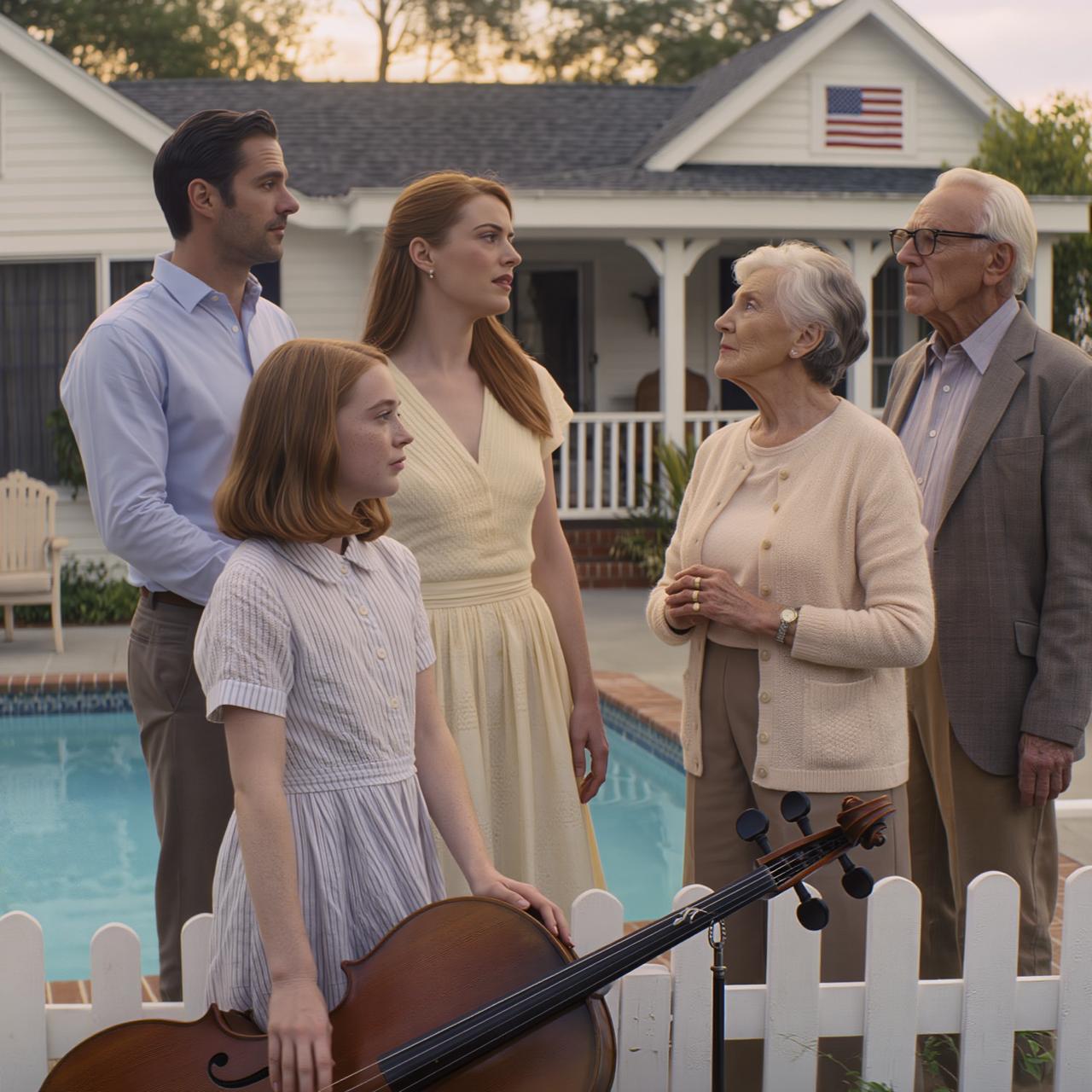
We drove across town in my aging car, the trunk crammed full, the cello case buckled carefully in the backseat like a precious passenger.
When we unlocked the front door of the house, it felt completely different.
No contractor trucks in the driveway. No performative string lights on timers. No fake laughter echoing from the backyard.
Just genuine quiet.
The kind that feels earned through struggle.
We slept there that first night on mattresses placed directly on the floor. The house creaked in new, unfamiliar ways. The heater kicked on with a gentle hum. Somewhere in the distance, a train passed through. But the place itself felt like it was breathing easier, more freely.
A week later, my grandmother moved back in properly.
Not as someone being “taken care of” reluctantly. Not as an inconvenience squeezed into a spare room.
As the person who belonged there all along.
Lucy helped her unpack like it was a celebration worth having. Carrying sweaters, books, framed photographs, and that little tin of peppermint tea like each item was a vote for a better future.
And then, like it was the most natural thing in the world, my grandmother sat in the living room while Lucy practiced her cello.
No shrine of tense silence. No tight, forced smiles. No “inside voice, sweetheart” corrections.
Just music filling a house that finally knew exactly who it was for.
When spring returned and the maple trees in the neighborhood budded out fresh and green again, Lucy auditioned for the regional youth orchestra in the city.
She wore her best dress and the same small necklace my grandmother had once worn at her own recitals decades ago. We drove downtown past the stadium and the courthouse, parked in a crowded lot, and walked into a building that smelled like rosin and concentrated nerves.
She got accepted.
But this time, she had her proper instrument.
And something else even more valuable.
Continúa leyendo con «SIGUIENTE »»»