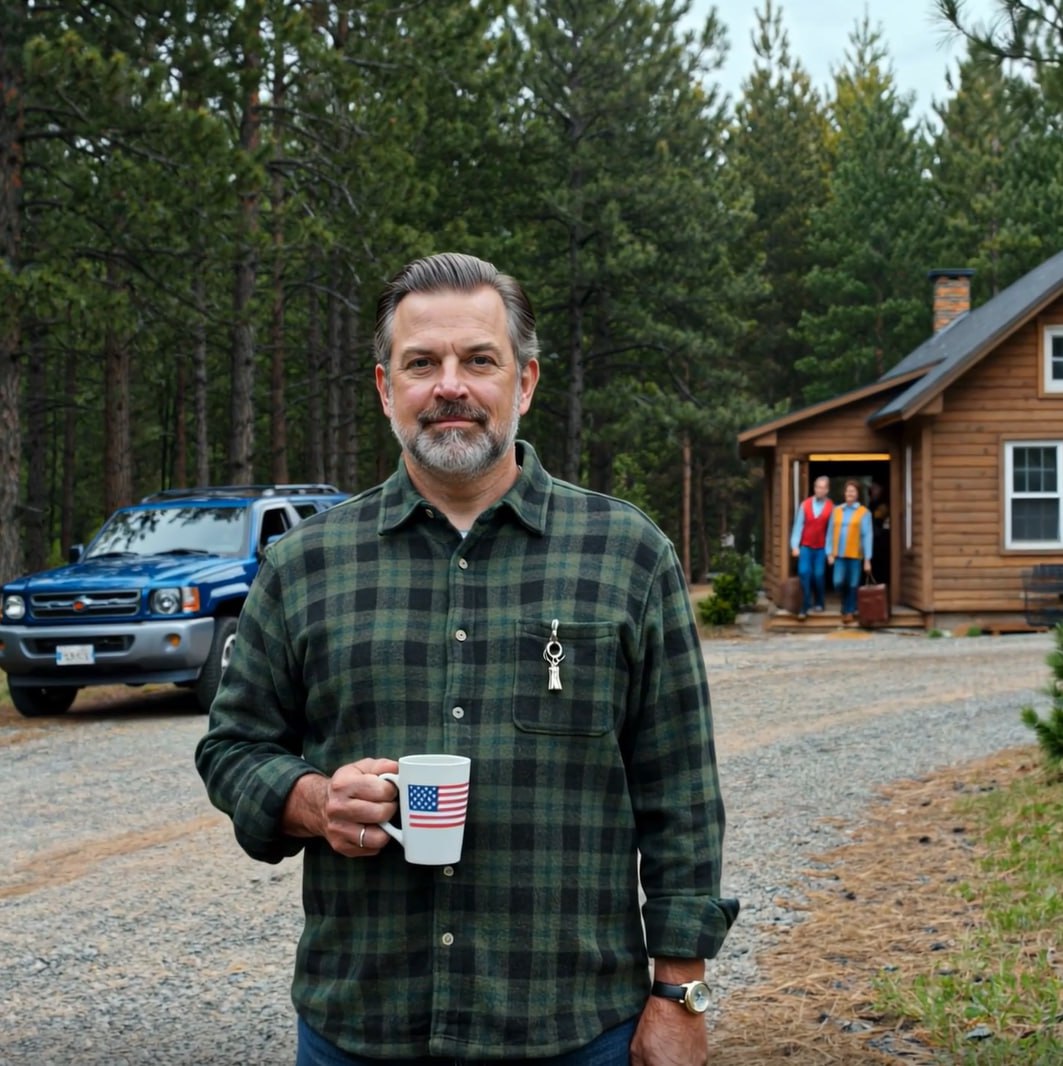
The evening was clear. Elk grazed in the clearing. The mountains stood eternal in the distance. A small American flag on the porch post moved lazily in the September breeze.
I rocked slowly, rhythmically, and allowed myself to feel the weight lifting. Not gone completely. Bula still needed to heal, the divorce needed to finalize, Leonard and Grace still needed sentencing. But lifting.
The immediate danger was over. My daughter was safe. My property was secure.
Almost finished, I thought. Just one more chapter to write. The one where we figure out what peace actually looks like.
Two weeks later, I sat in a federal courtroom in Cheyenne, Wyoming, attending Leonard and Grace’s sentencing hearing. I didn’t have to be there. The prosecutor hadn’t required my presence. But I needed to see this through to the end.
Leonard and Grace stood before the judge, looking diminished in their federal court attire. Their attorney had negotiated a plea deal. Guilty pleas to reduce charges in exchange for lighter sentences.
The judge reviewed their criminal history, none, and their ages, then the evidence of their guilt, which was overwhelming. An American flag hung behind him, perfectly still in the air-conditioned courtroom.
“Mr. and Mrs. Harrison,” the judge said, “you’ve pleaded guilty to benefits fraud. The court accepts your plea agreement. I want to be clear about the severity of your actions. You exploited systems designed to help citizens in genuine need.”
“Yes, Your Honor,” Leonard said quietly.
“Two years supervised probation,” the judge continued, “forty-five thousand in restitution and fines, permanent ban from federal and Wyoming state benefit programs. You’ll report monthly. Any violation results in immediate imprisonment. Do you understand?”
“Yes, Your Honor,” they said in unison.
“You’re fortunate to avoid prison,” the judge said. “Don’t squander this opportunity. Dismissed.”
As I left the courthouse, Leonard caught my eye across the lobby. A moment of mutual recognition. He looked away first, defeated. I felt no triumph, only closure.
Bula told me later that Cornelius had moved to a small efficiency apartment in a cheaper area of Denver. He took minimal belongings, whatever fit in his car.
“I saw him one final time when he came for his things,” she said. “He looked like a stranger. Not angry, just empty.”
He signed the final divorce papers without a word and left.
The divorce was finalized by mid-September. Bula legally resumed her maiden name. Bula Nelson.
With my help, she found a small two-bedroom house in Cody, about fifteen minutes from my cabin. It was modest but charming, older construction that needed updates but had good bones and a view of the Absaroka Mountains.
I provided the down payment as a gift. Bula secured a mortgage for the remainder using her teaching income and her own excellent credit. She also landed a third-grade position at Cody Elementary School, starting immediately, trading Denver traffic for kids who came to school in cowboy boots and jackets with little American flag patches sewn on.
I helped her move in, spending a weekend painting rooms and assembling furniture. Simple work, but profoundly meaningful. Rebuilding our relationship through practical acts of service.
Healing wasn’t linear for Bula. Some days she was optimistic about her fresh start. Other days she was angry at Cornelius, at herself, even at me for not telling her earlier. I listened without defending myself, understanding she needed to process complex grief.
We fell into a routine. Sunday dinners together, alternating between her place and mine.
During one dinner, while we chopped vegetables together in her new kitchen, she asked, “Do you think I’ll ever trust anyone again? Ever want to remarry?”
I set down my knife.
“Honestly, I don’t know,” I said. “But that’s okay. Trust isn’t something you’re supposed to give freely to everyone. It’s earned slowly, through consistent actions over time. Anyone worth having in your life will understand that.”
She smiled, small but genuine. “When did you get so wise?”
“I’m not wise,” I said. “I’m just old enough to have made mistakes and learned from them.”
On a crisp late-September evening, Bula drove to my cabin for dinner. We cooked together, nothing fancy, just spaghetti and salad, and ate on the porch despite the cooling weather.
As the sun set, painting the mountains in orange and gold, a small herd of elk emerged from the tree line to graze in my clearing. We sat in matching rocking chairs. I’d bought a second one after she moved nearby. We watched in comfortable silence.
Then Bula said quietly, “Thank you, Dad. For everything. For fighting for me, even when I didn’t understand it. For being patient while I figured things out.”
Emotion tightened my throat.
“You don’t need to thank me,” I said. “You’re my daughter. I’ll always fight for you.”
“I know,” she said. “But I want to. You could have walked away and protected just yourself. You didn’t.”
“That was never an option,” I replied. “Family means we protect each other even when it’s hard.”
“I’m sorry I didn’t believe you sooner,” she said.
“Don’t apologize for being loyal to your marriage,” I answered. “That speaks well of you.”
She smiled, really smiled, for the first time in months.
“Look at that big bull elk,” she said. “He’s magnificent.”
“That’s my favorite,” I said. “I see him almost every evening.”
I smiled back at her. “Welcome to the neighborhood, honey. You’ll get to know all the regular visitors.”
“I already love it here,” she said. “This feels like home.”
“It is home,” I said, “for both of us now.”
Later, after Bula drove away, I remained on the porch, rocking slowly, watching the last light fade from the sky.
I thought back to March, buying this cabin in the Wyoming woods, filled with hope for peaceful retirement, then having that peace threatened by Cornelius’s ultimatum. “My parents are moving in with you. If you don’t like it, come back to the city.”
The journey from March to September felt like years, but I’d navigated it without losing myself, without becoming cruel, without abandoning my values. I’d protected what mattered using law and strategy instead of retaliation and rage.
My daughter was safe, building a new life nearby. My property was secure. My autonomy intact. The antagonists faced appropriate consequences, but weren’t destroyed beyond recovery. They could rebuild if they chose better paths.
As stars appeared above the mountains, I allowed myself a small smile.
Continúa leyendo con «SIGUIENTE »»»