Part 1: The Man Everyone Laughed At
The first time they said my children would die, I didn’t argue.
I just kept digging.
Pennsylvania, 1876 wasn’t the kind of place that forgave mistakes. Out on the edge of the Allegheny Plateau, a bad decision didn’t mean embarrassment—it meant frostbite, sickness, or a shallow grave before spring thaw.
And according to every man within ten miles, I had made the worst decision they’d ever seen.
My name is Lars Nystrom. I came to this country with a wife, two children, and a skill nobody here respected until it was too late.
Back home in Sweden, I wasn’t just a builder. I was a log scribe—someone who could take two crooked, stubborn trees and make them fit together so tight not even wind could whisper through the seam.
Out here?
That didn’t mean a damn thing.
Because in America, especially on the frontier, men believed in speed over precision. Big fires over tight walls. More wood over better thinking.
And that belief was about to cost them everything.
The First Winter Broke Us
I still remember the sound.
Not the wind outside—but the wind inside.
It crept through the walls of our first cabin like something alive. A constant, whispering hiss that never stopped. You couldn’t see where it came from, but you could feel it—sliding across your skin, slipping under blankets, stealing heat one breath at a time.
My son Oscar woke up one morning with frost in his hair.
Inside the house.
My daughter Ingrid stopped complaining after a while. That was worse. Kids don’t go quiet unless something’s wrong.
Elin—my wife—she tried to hide it. Heating stones in the fire, wrapping them in cloth, tucking them into the children’s beds like some kind of ritual against the cold.
It didn’t work.
Nothing worked.
We burned wood constantly. Stacked cord after cord like it was the only thing keeping death outside the door.
And still… we froze.
The Night I Knew I Failed
There was one night I’ll never forget.
The fire had burned low. I woke up because the air hurt to breathe.
Actually hurt.
I sat up and saw something that made my stomach drop.
Our breath—mine, Elin’s, the children’s—had frozen into a thin crust across the inside of the blankets.
Frost.
Growing from us.
That’s when I understood something the others didn’t.
The problem wasn’t the cold.
The problem was the air.
The Men Who Knew Better
Spring came, and with it, the men.
Frontier experts. Builders. Survivors.
Men like Abel Rourke.
You could hear his wagon before you saw him—heavy wheels grinding over frozen dirt, the creak of old oak under weight. He was the kind of man people listened to. Not because he was kind, but because he was always certain.
And out here, certainty passed for truth.
He stopped by my claim one morning while I was working.
Didn’t greet me. Didn’t need to.
Just spat into the dirt and looked at what I was doing.
“What the hell is that supposed to be?”
Behind him were Caleb Finch, the sawyer, and Jedediah Stone—the kind of men who measured worth in calluses and timber stacked.
They were expecting to see a foundation.
Posts.
Something normal.
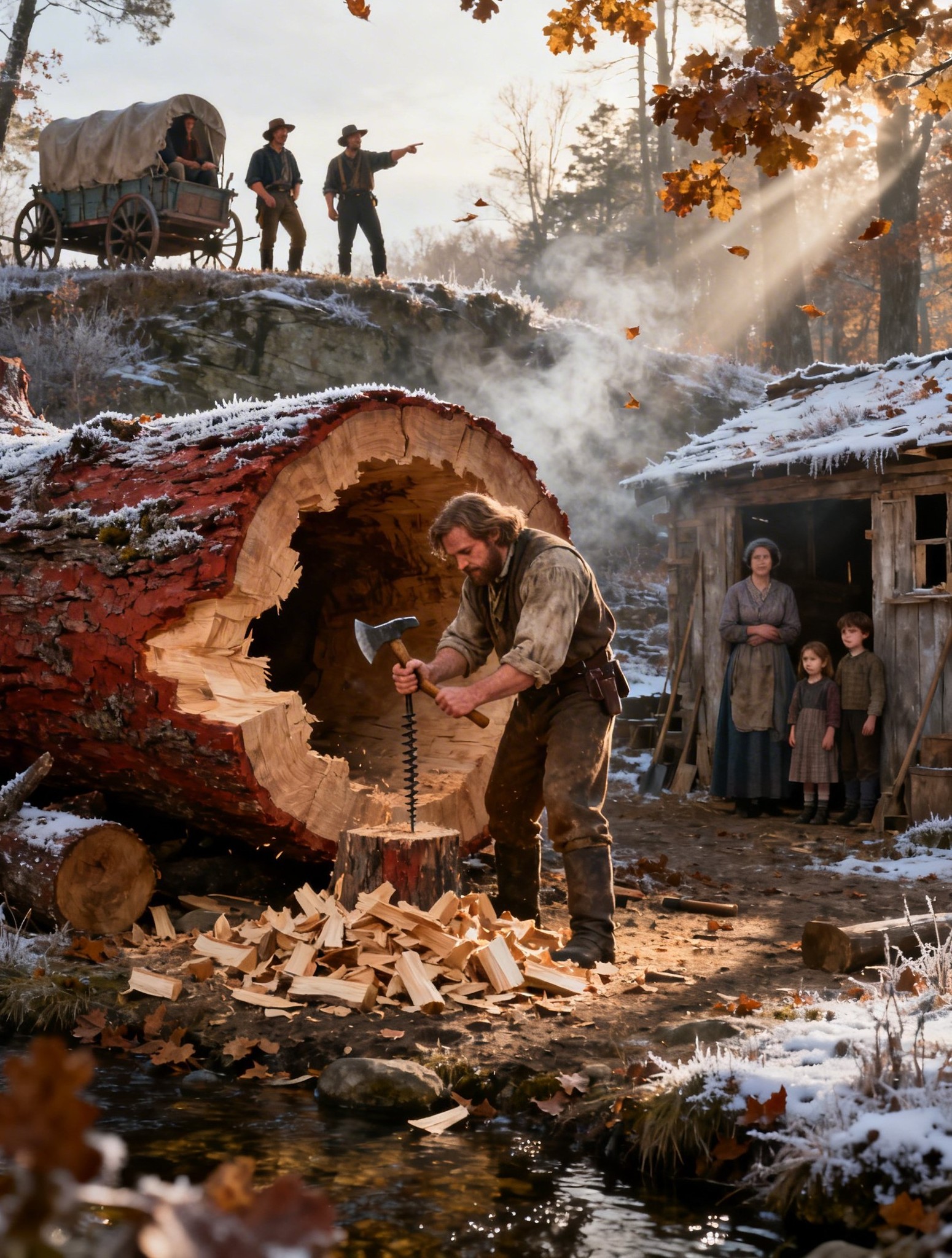
Instead, they saw me standing inside a massive fallen oak, swinging an adze into its heart like I’d lost my mind.
The Tree
It was the biggest red oak I’d ever seen.
Five feet thick at the base. Torn down by a summer storm, lying across the slope like something ancient that had finally given up.
To them, it was firewood.
To me?
It was already half a house.
They just couldn’t see it yet.
“You’re Digging Your Own Grave”
Rourke climbed down from his wagon, boots crunching on the frost-hardened ground.
“Still at it?” he called.
I didn’t answer right away. Just kept working.
The adze bit into the wood with a dull, heavy thunk. Chips flew. The smell of oak filled the air.
Finally, I leaned on the handle and looked up.
“Yes.”
He laughed.
Short. Sharp. Mean.
“You planning to live in that thing?”
“Yes.”
That got the others smiling.
Finch shook his head. “Heartwood’s already going soft. You see that color? You’re carving yourself a moldy coffin.”
Stone added, “More work than building a proper cabin. Twice over.”
Then Rourke stepped closer, voice dropping like he was explaining something to a child.
“The damp will kill you. Not the cold. That thing will sweat, rot, and choke you out before winter’s halfway through.”
He waited for me to argue.
I didn’t.
I just said the only thing that mattered.
“The wind will not find my children this winter.”
Laughter Travels Far
They didn’t just laugh that day.
They laughed for weeks.
Every wagon that passed slowed down.
Every man had something to say.
“Building himself a burrow.”
“Man thinks he’s a damn badger.”
“Swede’s gone soft in the head.”
Even some of the women shook their heads when they came by with water or traded goods with Elin.
Pity at first.
Then something worse.
The kind of look people give when they’ve already decided how your story ends.
They Thought I Was Fighting the Wrong Enemy
And maybe that’s why they couldn’t understand.
Because they thought winter was something you fought with fire.
Bigger flames. More wood. Stronger walls.
But I had already seen the truth.
You don’t fight the cold.
You stop the heat from leaving.
The Work That Made No Sense
What I was doing looked insane.
I won’t pretend otherwise.
Instead of cutting the tree into logs, I was hollowing it out.
Day after day.
Drill.
Chop.
Clear.
Again and again until my hands went numb and my shoulders burned like they were tearing apart.
Oscar and Ingrid played in the pile of wood chips. It grew so high they could climb it like a hill.
To everyone else, it looked like wasted effort.
To me?
Every inch I carved out was another pocket of still air.
Another layer between my family and death.
Elin Never Asked Me to Stop
That’s the thing that stayed with me.
She never told me I was wrong.
Not once.
But one evening, after the others had left and the woods went quiet, she stood beside the log and looked at what I’d made so far.
It wasn’t much yet. Just a hollow starting to take shape.
“It looks like something alive,” she said softly.
“Like it’s sleeping.”
I wiped sweat from my hands.
“It will keep us warm.”
She didn’t smile.
But she nodded.
And that was enough.
The Real Problem No One Saw
The others kept patching cracks.
Stuffing moss into gaps.
Smearing mud into seams.
Fighting the symptoms.
But the real problem wasn’t the holes.
It was the movement.
Air coming in.
Air going out.
Heat being carried away like it had somewhere better to be.
Their cabins weren’t shelters.
They were engines.
Machines designed to pull cold in and push warmth out.
And they didn’t even realize it.
I Wasn’t Building a House
I was building a trap.
Not for animals.
For air.
The Warning Came Too Late
Rourke came back one more time before the first frost.
This time, he didn’t laugh.
He looked… annoyed.
Like my stubbornness had become a personal insult.
“You’re not right, Nystrom,” he said.
“You think you’re smarter than everyone out here.”
I shook my head.
“I think the wind is stronger than all of us.”
He stepped closer.
“You keep this up, I won’t help you when it goes bad.”
I met his eyes.
“I’m not asking you to.”
That’s when something changed.
The laughter stopped.
And the resentment started.
Because now it wasn’t just that I was wrong.
It was that I refused to admit it.
And men like Abel Rourke?
They don’t forgive that.
The First Frost
The morning the ground froze, I was already inside the log.
The hollow was nearly complete.
The walls were thick. Solid. Heavy with the weight of the tree’s life.
For the first time, I stood inside it and just listened.
No wind.
No whispering.
Just silence.
The kind of silence that felt… safe.
I closed my eyes.
And for the first time since coming to America—
I believed we might survive the winter.
But survival wasn’t the part that would change everything.
It was what happened when winter came for the others.
And they realized the man they laughed at…
Had built the only warm place for miles.
Part 2: The Cold Came for All of Them
The first real freeze didn’t arrive like a storm.
It arrived like a verdict.
It started quietly.
A thin skin of ice over the creek. Frost clinging to the last leaves like something fragile and temporary. The kind of cold that makes a man pull his coat tighter but still believe he’s in control.
That illusion lasted exactly three days.
By the fourth morning, the wind changed.
You could hear it before you felt it—a low, distant roar rolling across the plateau like something alive and hunting. It came down from the north, from Canada, carrying a kind of cold that didn’t belong to men.
This wasn’t weather.
This was pressure.
And it was coming for everything.
The Settlement Prepares—Wrong
Men like Abel Rourke didn’t panic.
They prepared.
Axes swung harder. Woodpiles doubled. Chimneys were cleaned and fires laid in advance. Women sealed windows with cloth and clay. Children were told to stay close, stay quiet, stay inside.
It all looked right.
It all felt right.
And it was completely useless.
Because they were preparing to fight the cold—
Not the wind.
My Work Was Almost Done
Inside the oak, things were different.
By the time the first real freeze hit, I had already sealed the ends.
Not with planks like the others would’ve done.
No.
I found two trees with natural curves that matched the openings almost perfectly. Took days just to drag them back. More days to shape them.
That was where my real work began.
Scribing.
The tool I used looked simple—two steel points fixed at a distance. But it did something most men out here had never even imagined.
One point traced the uneven edge of the hollow log.
The other carved that exact shape into the new piece.
Perfectly.
Every rise, every dip, every imperfection mirrored.
I cut slowly. Carefully. Listening to the grain more than the sound of my own breath.
When I finally set the first end piece into place, it didn’t just fit.
It locked.
No gaps. No seams. No space for air to whisper through.
I didn’t smile.
But I slept better that night.
They Were Watching Again
Word had spread.
Not laughter this time.
Suspicion.
Men started stopping again, but they didn’t call out as much. They just stood there, arms crossed, watching.
Trying to understand.
Trying to find the flaw.
Because if there wasn’t one…
Then maybe they’d been wrong.
And that thought scared them more than winter.
The Door That Didn’t Leak
The last thing I built was the door.
Not big. Just enough to step through.
But it mattered more than anything else.
Because one bad seal there—and everything I’d done would be worthless.
I carved it from a solid slab, shaped to sit tight within the frame. No hinges like you’d see in town. Just a simple pivot and weight, balanced so it settled into place naturally.
When it closed, you could feel it.
Not hear it.
Feel it.
Like something sealing.
Like the outside world had just been… cut off.
The Earth Became the Wall
Once the structure was complete, I did something the others mocked more than anything else.
I buried it.
Not fully.
But enough.
I rolled the log onto a bed of flat stones—lifting it off the ground just enough to keep moisture from creeping in. Then I packed clay and moss underneath, tight and dense.
After that, I banked earth up along the sides.
Higher.
Higher.
Until the log didn’t look like a house anymore.
It looked like part of the hill.
A mound. A shape. Something natural.
Something that didn’t fight the wind—
But made the wind irrelevant.
“You’ve Lost Your Damn Mind”
Rourke came back the day I started covering it.
This time, he didn’t bring anyone with him.
That should’ve told me something.
He stood there for a long time, watching me shovel dirt against the side of the log.
“You’re burying it,” he said finally.
“Yes.”
“Why?”
I leaned on the shovel.
“The wind can’t touch what it can’t reach.”
He stared at me like I’d just spoken another language.
“You think dirt’s gonna keep your family alive?”
“No,” I said. “The air will.”
That’s when he snapped.
“You keep talking like you understand something the rest of us don’t!”
I didn’t answer.
Because I did.
The First Night
The temperature dropped fast.
Too fast.
By the time the sun went down, the ground was already hard. The kind of cold that turns mud into stone and breath into smoke.
Inside the log, we lit the stove for the first time.
Just a small one. Cast iron. Nothing impressive.
I didn’t load it with wood the way the others would.
Just a few pieces.
Elin noticed.
“That’s all?” she asked quietly.
“It’s enough.”
She didn’t argue.
But I saw the worry in her eyes.
I felt it too.
Because this was the moment.
The point where I was either right—
Or I had doomed my family.
The Air Didn’t Move
At first, it felt cold inside.
Not freezing.
But still.
Different.
The kind of cold that sits instead of biting.
Then the fire caught.
The metal of the stove clicked and shifted as it warmed. A soft, steady sound.
Minutes passed.
Then more.
And something strange happened.
The warmth didn’t rise.
It didn’t drift.
It just…
Stayed.
No Draft
I lit a candle and set it on the small table.
Not for light.
For proof.
In our old cabin, the flame never stood still. It flickered constantly, pulled by invisible currents, dancing to the rhythm of leaks and drafts.
Here?
It didn’t move.
Not even a tremble.
Just a steady, quiet flame.
I stared at it longer than I should’ve.
Because that little flame told me everything I needed to know.
The air was trapped.
Still.
Alive with heat—and unwilling to give it up.
The Children Slept
That night, for the first time since we came to America—
My children slept without waking.
No shivering.
No coughing.
No restless turning under heavy blankets.
Just sleep.
Deep.
Peaceful.
Safe.
Elin noticed it too.
She didn’t say anything.
But I saw her sit there in the dim light, watching them like she didn’t quite believe it was real.
Outside, the World Was Breaking
The storm hit full force the next day.
Wind howled across the plateau, tearing through the trees like it wanted to strip the land clean. Snow came sideways, driven by a force that didn’t care about walls or doors or human effort.
You could hear it.
Even inside the log.
A distant, muffled roar.
Like standing underwater while something violent happens above.
But it couldn’t reach us.
The Others Started Burning More Wood
I didn’t need to see it to know.
I could smell it.
Even through the sealed walls, faint traces of smoke drifted through the air outside. Heavy. Constant.
They were feeding their fires like desperate men.
Because that’s what they were.
Desperate.
Day Three
The temperature dropped below zero.
Then lower.
The kind of cold that doesn’t just freeze water—
It freezes thought.
Makes your fingers slow. Your breath shallow. Your body question every movement.
Inside the log?
We sat in shirtsleeves.
Not hot.
Not even warm in the way a fire makes you feel.
Just…
Comfortable.
Even.
The kind of temperature your body doesn’t fight.
Elin Finally Asked
On the third night, she looked at me across the table.
“How?” she said.
Just one word.
I thought about it.
Then I pointed to the candle.
“The air doesn’t move,” I said.
She followed my gaze.
The flame stood perfectly still.
Outside, the wind screamed.
Inside, nothing answered.
Day Five—Something Broke
It wasn’t the storm.
It was them.
You could feel it in the silence between the gusts.
The kind of silence that meant something had gone wrong.
And then—
A sound.
Faint at first.
Then louder.
A shout.
I stood up.
So did Elin.
We both knew what that meant.
Because men don’t leave their homes in weather like this—
Unless staying inside has become worse.
And that’s when the first one came running across the snow toward our hill.
Not to laugh.
Not to mock.
But because something inside his own home…
Had finally failed.
Part 3: The First Man Who Came Running
I remember the exact moment I realized something had changed.
It wasn’t the sound of the wind.
It wasn’t the snow.
It was footsteps.
Panicked. Uneven. Breaking through frozen ground like the man making them didn’t care if he fell.
That’s not how men move in an Allegheny winter.
That’s how men move when something inside their home is worse than the cold outside.
He Came From Rourke’s Land
I stepped outside.
The air hit me like a wall—not because it was cold, but because it was alive. The wind tore across the plateau in violent sheets, flattening snow into razor-thin waves.
And there he was.
A man from the lower ridge.
One of Rourke’s neighbors.
I recognized him by his gait before I even saw his face.
He was running wrong—leaning forward too far, arms stiff, like his body had stopped cooperating with his will.
When he saw me, he nearly collapsed.
“Your place—” he gasped.
He couldn’t finish.
He just pointed behind him, shaking.
“It’s freezing inside the house”
That’s what he said.
Not outside.
Inside.
I didn’t respond right away.
Because I already knew what had happened.
I just didn’t expect it this fast.
He swallowed hard, breath coming out in sharp bursts.
“We burned everything. Everything. The wind still—still coming through. The stove can’t keep up. My boy—he’s shaking so bad he—”
He stopped.
Couldn’t say it.
Didn’t need to.
I understood.
The Moment They Realized Fire Wasn’t Enough
People believed fire was power.
That if you made it big enough, nothing could beat it.
But fire doesn’t stop air.
It only warms what air allows it to touch.
And their cabins—
Their beautiful, “proper” cabins—
Were full of air that never stayed still.
Air that carried heat away like theft.
Air that turned their homes into machines feeding the winter.
I Let Him Inside
I didn’t hesitate.
I opened the door.
And the world outside stopped mattering.
He stepped in slowly, like he didn’t trust what he was seeing.
The silence hit him first.
That’s always what hits them first.
No wind.
No creaking boards.
No draft crawling along the floor like something alive.
Just stillness.
Absolute stillness.
He looked at the candle on the table.
The flame didn’t move.
Not even a flicker.
His mouth opened slightly.
Then closed again.
Like he’d forgotten how words worked.
“How is it not freezing in here?”
He whispered it.
Not to me.
To the room.
I looked at him.
“The air doesn’t move,” I said again.
Same answer.
Same truth.
He didn’t understand it.
Not yet.
But his body did.
Because his shoulders dropped.
Just a little.
Like something inside him finally realized it didn’t have to fight anymore.
Outside, His Fear Was Still Running
He kept glancing back at the door.
Like the storm might follow him in.
Like safety was temporary.
That’s what happens when you’ve lived too long inside a losing system.
You stop trusting calm.
“My wife said I was going mad”
He laughed once.
Short.
Broken.
Then shook his head.
“I thought it was the fire. I thought maybe the chimney was blocked. I checked everything. Everything.”
He looked at me now.
Eyes red.
Not from cold.
From exhaustion.
“You didn’t just build a house,” he said quietly. “You built something else.”
I nodded once.
“Yes.”
He waited.
I didn’t elaborate.
Because I didn’t need to.
The Lesson No One Wanted to Hear
They believed comfort came from effort.
More wood.
Bigger fire.
Thicker walls.
But they never understood the real enemy.
Not cold.
Not snow.
Not even wind alone.
It was movement.
Air that refused to stay still.
Air that carried warmth away faster than any fire could replace it.
Continúa leyendo con «SIGUIENTE »»»