My dad, Jack Dalton, is 74 years old and spent fifty years at the GM plant in Anderson. He is the kind of man who expresses love through presence, who shows up with his toolbox when your water heater goes out at ten on a Sunday night and waves off any thanks like it embarrasses him. His garage smells like motor oil and cold concrete and something I cannot name exactly except to say it smells like reliability, like all the years he kept things running when they had no right to keep running. When I was a kid and something broke, we did not panic. We waited for Dad. That smell meant the problem was going to get solved.
Karen’s family has different standards. The polished kind, the kind that come with unspoken rules about presentation and vocabulary and the particular social hierarchy that organizes people by the cleanliness of their hands. Her parents, Don and Margaret Whitfield, had made their money in commercial real estate and had spent the subsequent decades treating that money as evidence of character rather than circumstance. They were not openly rude to my father. They were something worse: they were performatively gracious, the kind of gracious that reminded him, in every exchange, that their graciousness was a choice they were making rather than something he had simply earned by being a decent human being.
I had been swallowing this for twelve years.
Not because I agreed with it. Not because some part of me thought my father’s fifty years of labor made him less worthy of a seat at a holiday table. I swallowed it because I told myself that keeping the peace on Thanksgiving was worth the cost, that I could navigate between these two worlds if I just stayed quiet enough and managed carefully enough, and that the discomfort was mine to absorb because that was what you did when you loved people who did not love each other.
I was wrong about all of it, but I did not understand that yet when I picked up the phone that Thursday morning.
It was around eleven. The turkey had been in the oven since nine, the whole house carrying that smell that is somehow the same in every house on every Thanksgiving, warm and inevitable. I called my dad to tell him I was heading over to pick him up, expecting his usual response, something corny about how he hoped I had enough room in the truck for a man who had eaten breakfast twice, followed by the familiar sound of him patting his pockets for his keys even though his keys were always on the same hook by the door.
Instead, his voice came careful. Measured in a way it almost never was. Like he was picking his way across something fragile and did not want to put his weight down wrong.
“Rick,” he said, “I don’t think I’m coming this year. Karen called last night. She said it was a small dinner and she didn’t want me to feel crowded.”
I stood in the kitchen with my phone pressed to my ear and felt the specific stillness that arrives right before something shifts in a way you cannot un-shift. The kind of stillness that is not calm at all but just the brief pause before understanding catches up to information.
“She called you,” I said.
“Last night, yeah. She was real nice about it. Said they had a lot of family coming and didn’t want me to feel overwhelmed.” He paused. “I figure she’s probably right. You know me, I’m not much for a crowd.”
My father was not not much for a crowd. My father had spent five decades on a factory floor and could talk to anyone within three minutes of meeting them. He was not making an excuse for himself. He was making one for her, because that was the kind of man he was, the kind who absorbed other people’s unkindness and repackaged it as something that made sense.
“I’ll call you back, Dad,” I said.
I walked into the dining room.
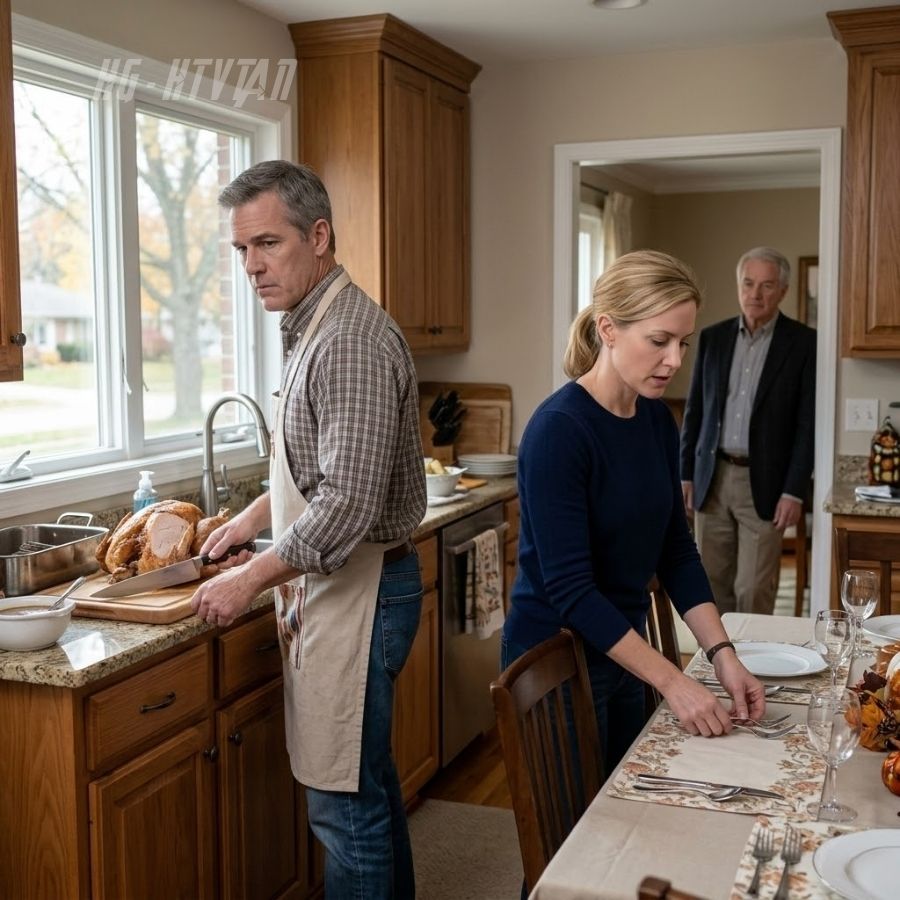
Karen was arranging silverware with the focused attention she brought to things she cared about, each piece placed with the precision of someone preparing for an audience. She had the good tableware out, the set that lived in the buffet and only came out for occasions she considered worthy of it. She did not look up when I came in.
“Why did you tell my dad not to come?” I asked.
She set down a salad fork and turned to face me with the expression of a woman who had anticipated this conversation and was ready for it.
“Rick,” she said, “my parents are particular. You know how they are. Your father smells like an old garage and I am not going to spend Thanksgiving apologizing for that to my mother.” She said it the way you say something you have considered and arrived at cleanly, without guilt, as though she was simply reporting a reasonable decision she had made on behalf of the household. “He’s not coming.”
I looked at her for a moment.
I am not a man who processes things quickly in the emotional register. I have always been better with problems that have physical solutions, things you can take apart and understand and reassemble correctly. What I was processing in that moment was not quick, but it was thorough, and what I understood by the end of it was that this was not about a smell. My father had always smelled like the work he had done for fifty years. That had never been a secret. Karen had known it since the first time she met him. She had sat at his table and eaten the food he cooked and accepted his help when the furnace in our first house went out during a February cold snap and he drove forty minutes to fix it at seven in the morning without being asked.
What this was about was a line. A line about who belonged in the room and who did not, about what kind of people the Whitfields considered worthy of their company, and about the assumption, held firmly for twelve years, that I would continue absorbing that line quietly because the alternative was a conflict nobody wanted on a holiday.
I picked up the carving knife that was sitting on the counter and set it back down, slowly, deliberately, because my hands needed something to do and because I was choosing, in that moment, not to say anything I would have to walk back later.
“Fine,” I said. “Then none of you are coming either.”
Karen looked at me with the expression of someone who has heard a sentence that doesn’t quite parse. “What does that mean?”
“It means what it sounds like,” I said.
“Rick, my parents are going to be here in an hour.”
“I know,” I said. “They can come. There just won’t be a dinner here.”
I want to be clear that I did not yell. I did not slam a single cabinet door or throw anything or give her the escalating confrontation she was bracing for. I had learned, over many years, that the most unsettling thing you can do in a situation where someone expects drama is to remain completely calm. I went back into the kitchen and stood in front of the oven for a moment with the mitts in my hands.
The turkey was perfect. Golden and fragrant, the skin tightened and browned the way it was supposed to be. There were sweet potatoes on the second rack, a green bean casserole on the counter, rolls that Karen had made from scratch because she was, despite everything, a genuinely good cook when she wanted to be. A pumpkin pie cooling on the far end of the counter. Everything she had wanted, presented the way she wanted it, for the people she had decided deserved it.
I started loading it into the foil trays I found in the cabinet above the refrigerator.
Karen came to the kitchen doorway and watched me for a moment with an expression cycling through confusion and then alarm.
“What are you doing?”
“I’m packing up dinner,” I said.
“Rick.”
“I heard you tell my father he wasn’t welcome in his son’s house on Thanksgiving because he smells like the work he’s spent his life doing,” I said, still moving, still steady. “I’m not sitting down to a dinner that was built on that.”
“So you’re going to ruin everything.”
I slid the sweet potatoes into a tray and pressed the foil down around the edges. “I’m going to go have Thanksgiving with my father. What you do with the evening is up to you.”
She said a number of things after that. That I was being childish. That her parents were going to be mortified. That I could not simply take the entire Thanksgiving dinner and leave. That I was making a huge mistake. I listened to all of it while I worked, and I did not argue with any of it, because arguing requires a belief that the other person might say something that will change your mind, and I had already understood, in the dining room, that my mind was not going to change.
The turkey went into a large foil roasting pan I found under the sink, the kind you use for exactly this kind of transport. I covered it carefully. I stacked the trays, carried them to the truck in two trips, and then went back for the pie.
My phone buzzed on the counter. Karen, texting from the next room: Where are you going with that. I left it.
The drive to my father’s house takes twenty-two minutes in normal traffic. On Thanksgiving morning in Fort Wayne, with most people already where they were going, it took seventeen. I drove through neighborhoods where the houses had their lights on and the smoke from fireplaces rose in thin lines against the gray November sky, and I felt something I had not felt in a long time, something that sat very close to the feeling of having made a decision that was correct all the way down.
My father’s house is a 1960s ranch on a corner lot with a detached garage that has never, in forty years, had an empty bay. There was always something in there being worked on, a neighbor’s lawn mower, a friend’s truck, whatever needed attention. The porch light was on. I could see the television through the front window, the blue flicker of some parade broadcast he always put on in the background on holidays even though he never actually watched it.
I knocked, which I usually did not do, and heard him get up from his chair with the deliberate care of a man whose knees have opinions.
He opened the door and looked at me, then looked at the foil trays in my hands, then back at me.
“Rick,” he said.
“Happy Thanksgiving, Dad,” I said. “You going to make me stand out here?”
He stepped back and let me in. His house smelled exactly the way it always had: a combination of coffee and the pine cleaner he used on the floors and, underneath everything, the faint petroleum ghost that had lived in his clothes and his hands for so long it had become part of the house itself. I had never once found that smell anything other than comforting.
I set everything on his kitchen table and started pulling back the foil. He stood in the doorway between the kitchen and the small living room and watched me with an expression I could not entirely read, something careful and a little uncertain.
“Karen know you’re here?” he asked.
“Karen knows,” I said.
He was quiet for a moment. “Everything all right?”
I looked at him. My father, who had worked fifty years to give me a life he hoped would be easier than his, who had driven forty minutes in February to fix my furnace without being asked, who had repackaged Karen’s dismissal the previous night as a concern for his own comfort rather than say anything that might cause difficulty for his son.
“No,” I said. “But it’s going to be.”
He nodded once, the way he nodded when something was understood and did not need to be said further. Then he went to the cabinet and got down two plates.
We ate Thanksgiving at his kitchen table, the one he had built himself in 1987 from a kit and refinished twice since then. The turkey was excellent. The sweet potatoes were slightly overdone from the travel and reheating, but my father ate two helpings and said nothing about it. We watched the end of the parade and then a football game neither of us particularly cared about, and we talked the way we talked when it was just the two of us, about the crew I was running and the carburetor he was rebuilding for a neighbor’s vintage Silverado and the winter that was coming and whether he needed me to check the weatherstripping on his garage doors.
He did not ask me again about what had happened. He did not need to. He had understood from the moment I appeared on his porch with foil trays what the essential facts were, and he was not a man who required those facts to be narrated back to him.
At some point in the late afternoon, sitting in his living room with coffee and pie, he said: “You didn’t have to do this.”
“Yes I did,” I said.
He looked at the television for a moment. “She’s your wife, Rick.”
“She is,” I said. “And you’re my father. And I should have said something a long time ago.”
He was quiet for a while. Then he said, “I didn’t mind, you know. Coming here instead of there. I always liked my own kitchen on holidays.”
Continúa leyendo con «SIGUIENTE »»»